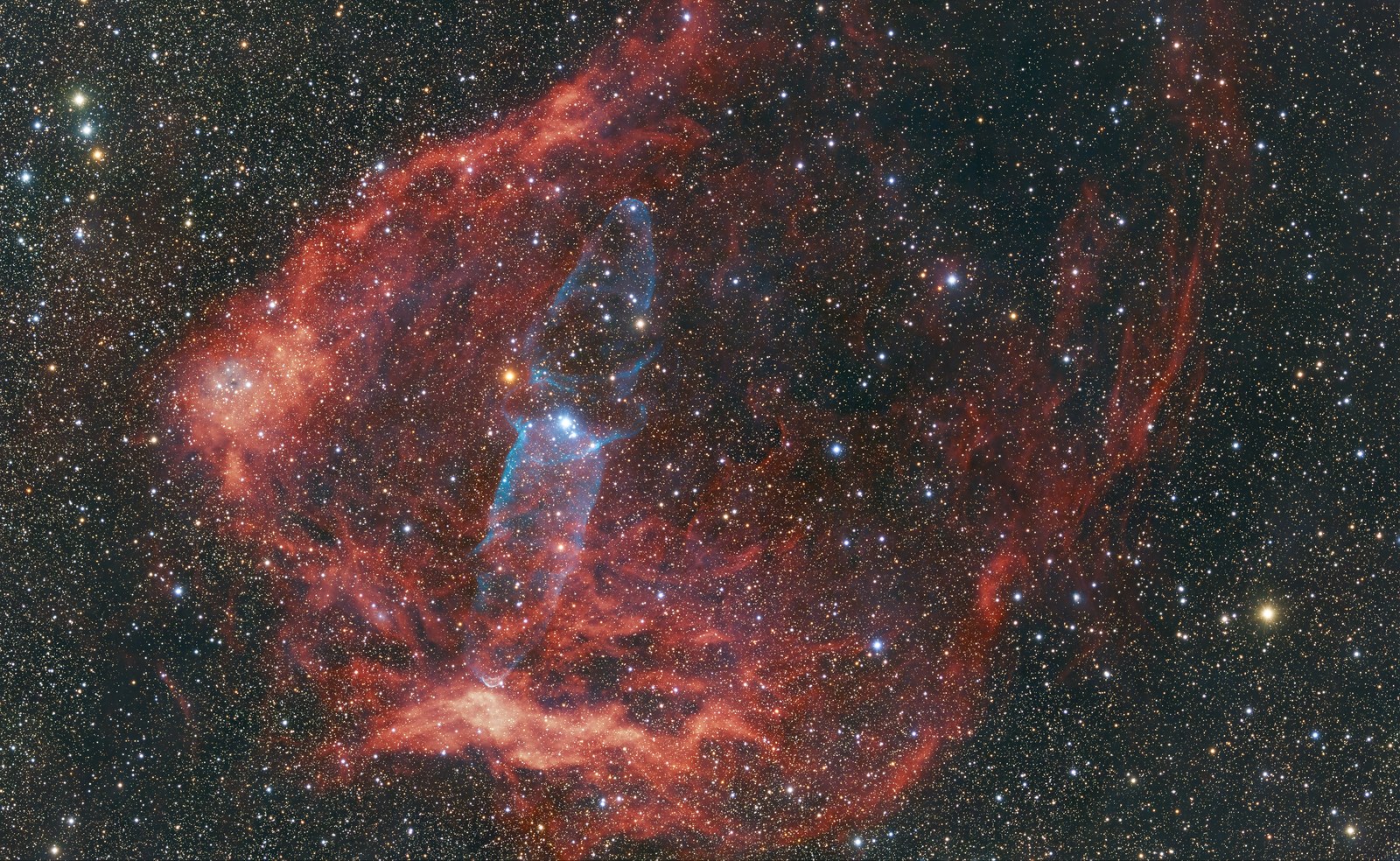
SH2-129 and Ou4: Two Superimposed Nebulae in Cepheus
SH2-129: The Flying Bat Nebula
In the constellation of Cepheus, SH2-129 is a vast cloud of hydrogen about 2,300 light-years away. Its reddish tendrils span several times the width of the full Moon, tracing an arched shape that evokes a bat with outstretched wings.
Its crimson glow comes from hydrogen, lit up by the radiation of young, hot stars nearby.
Ou4: An Amateur's Discovery
In June 2011, French astrophotographer Nicolas Outters stumbled by chance upon a second nebula nestled within the bat, which he named the Giant Squid (Ou4). If it stayed invisible for so long, it is because it only shows up in the light of a single gas, oxygen, which must be isolated with a special filter. Without it, this bluish ghost does not appear.
The Size and Nature of Ou4
Long suspected of being a mere line-of-sight alignment, the squid in fact seems to sit inside the bat itself, at the same distance. And it is enormous: nearly 50 light-years from end to end, twice the full Moon in the sky.
Its two opposing lobes evoke a planetary nebula, the bubble of gas a star breathes out at the end of its life; if it is one, it would dwarf every other one we know. Astronomers lean rather toward a flow of matter propelled some 90,000 years ago by a trio of hot stars hidden at its core.
A Photographic Challenge
Capturing this duo is a feat: these structures are so faint that it takes dozens of hours of exposure, often spread over several nights, through two filters, one for the red of the bat's hydrogen, the other for the blue-green of the squid's oxygen.
This photo was taken in collaboration with Maxime Lapagne from SAL (Société Astronomique de Liège).