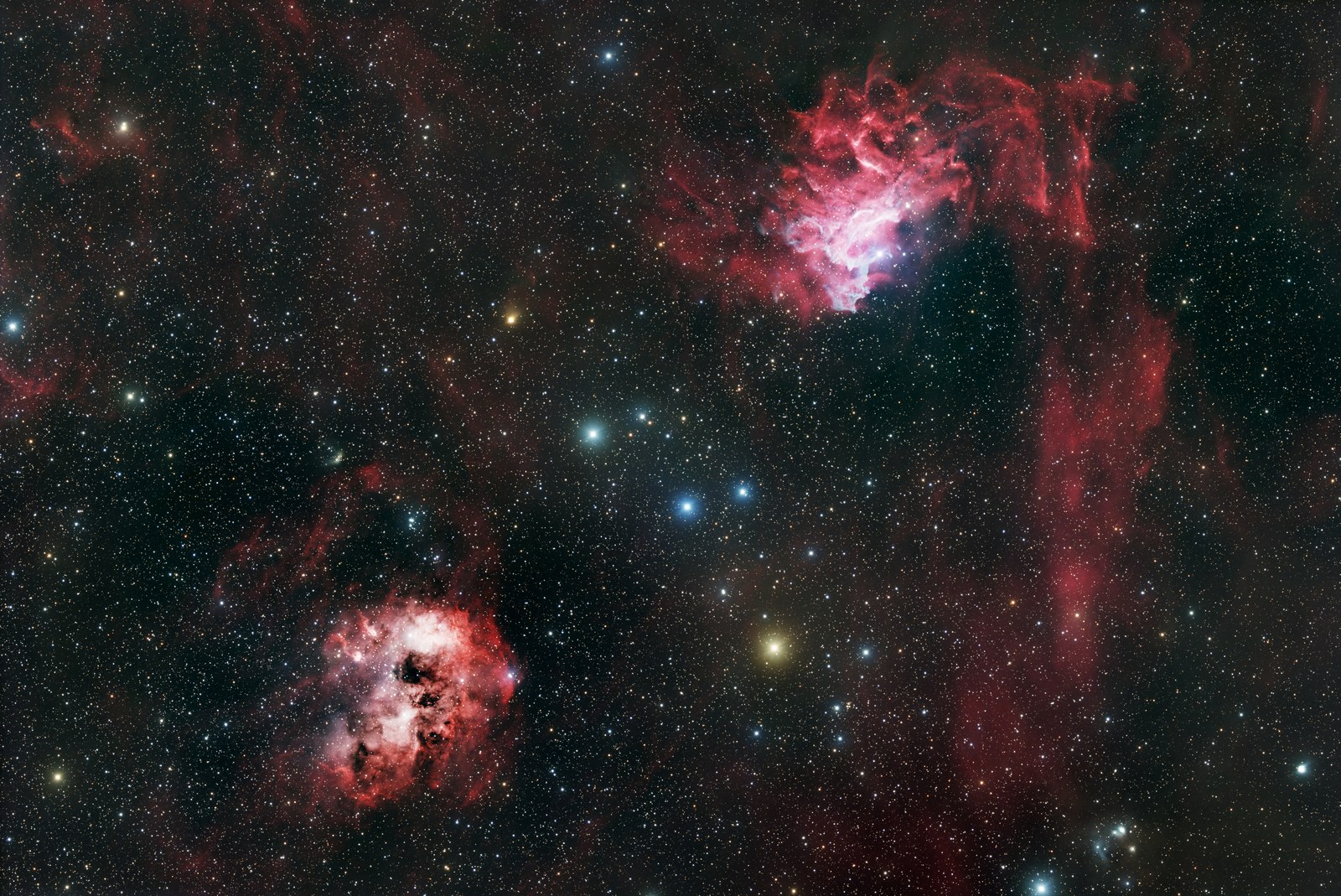
Flaming Star Nebula & Tadpole Nebula
Order a print From 219€
Or give this image as a gift
Gift idea · ArtBox Gift Edition
Open edition · gallery-quality print, ready to give. Wooden frame, matte finish, gift box. To hang or stand.
Finish : Matte
Description
In the constellation Auriga, two nebulae seem to sit side by side: in the upper right, the Flaming Star (IC 405); in the lower left, the Tadpoles (IC 410). Their closeness is only an effect of perspective: IC 405 is about 1,500 light-years from us, while IC 410 is eight times farther, around 12,000 light-years. Two unrelated objects, lined up by chance along the same line of sight.
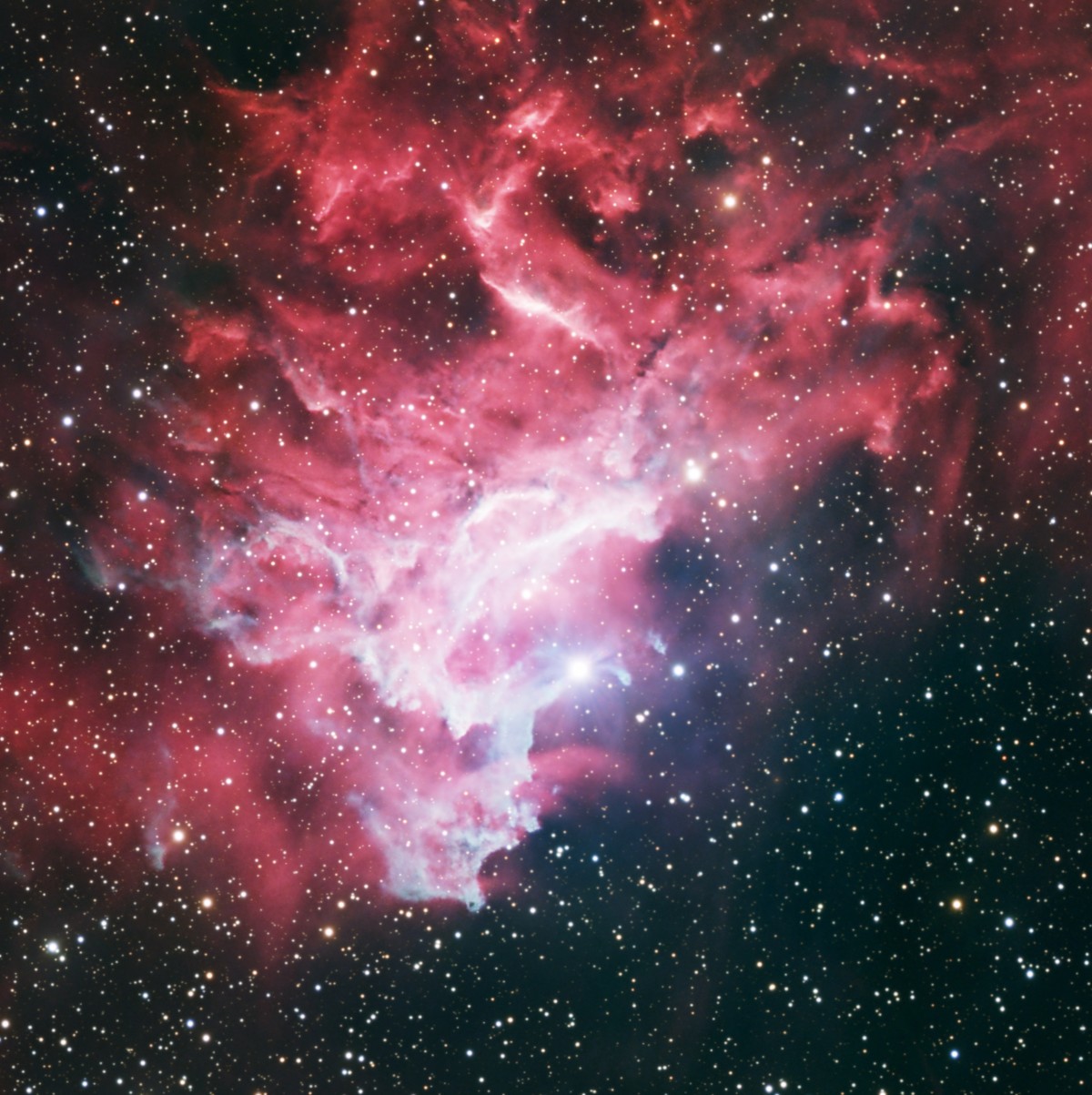
The Flaming Star owes its name and its glow to AE Aurigae, a massive, blazing star set at its centre. Its radiation lights up the hydrogen around it, and its light reflects off the dust, so the nebula blends two effects: the red of hydrogen shining by itself (emission) and the blue of dust returning the star's light (reflection). AE Aurigae is, what's more, a runaway star: ejected about two million years ago during a violent encounter near the Orion Nebula, it now races alone through this cloud that it merely happens to cross.
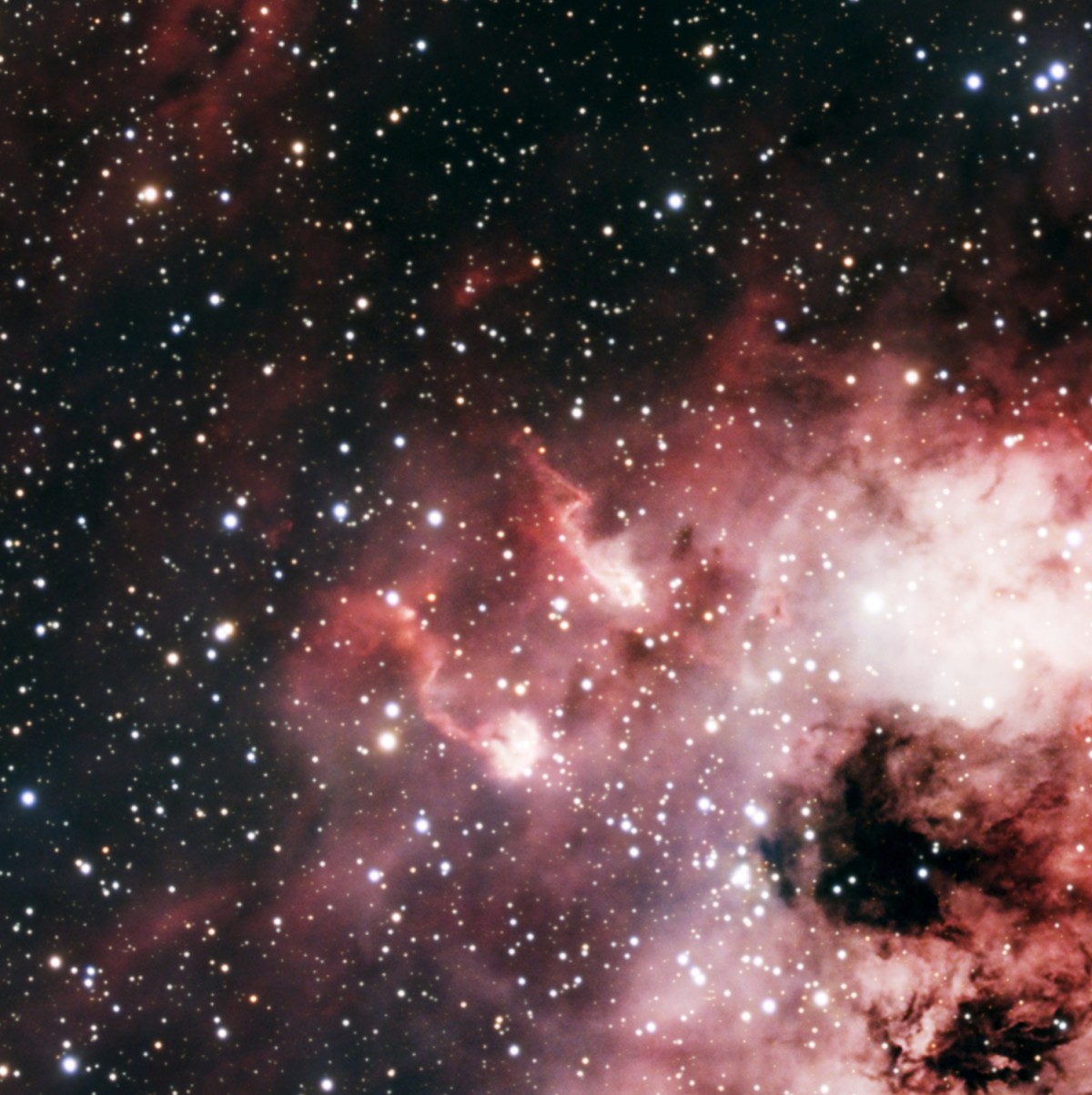
Far more distant and far larger, the Tadpole Nebula wraps around a young star cluster, NGC 1893, a few million years old. These hot stars carve and sculpt the gas around them. From this erosion two "tadpoles" are born: long columns of dense gas, about ten light-years long, whose tails are pushed away from the cluster by the stars' wind. They are cocoons where new stars form in turn.
Gathered in a single field, these two nebulae tell two stories at very different distances: a lone star on the run on one side, a bustling stellar nursery on the other. Both are H II regions, those great clouds of hydrogen that a young hot star sets aglow. And the dark areas of the field are the dust that partly veils them.
Technical details
- Location :
- Rockwood, Texas, USA (Starfront Observatories)
- Date :
- 13-18-19-20/12/2025
- Celestial Coordinates :
- RA: 05h 19m 7s
Dec: +33° 53' 58" - Acquisition :
- 411 x 240s (27h24)
- Calibration :
- Offsets + Flats
- Mount :
- ZWO AM5
- Optics :
- Celestron Rasa 8
- Camera :
- ASI2600MC Pro
- Filter :
- Antlia V-Pro Luminance 2"
- Distance :
- 1500 (IC405) / 12000 (IC410) light years
- Constellation :
- Cocher