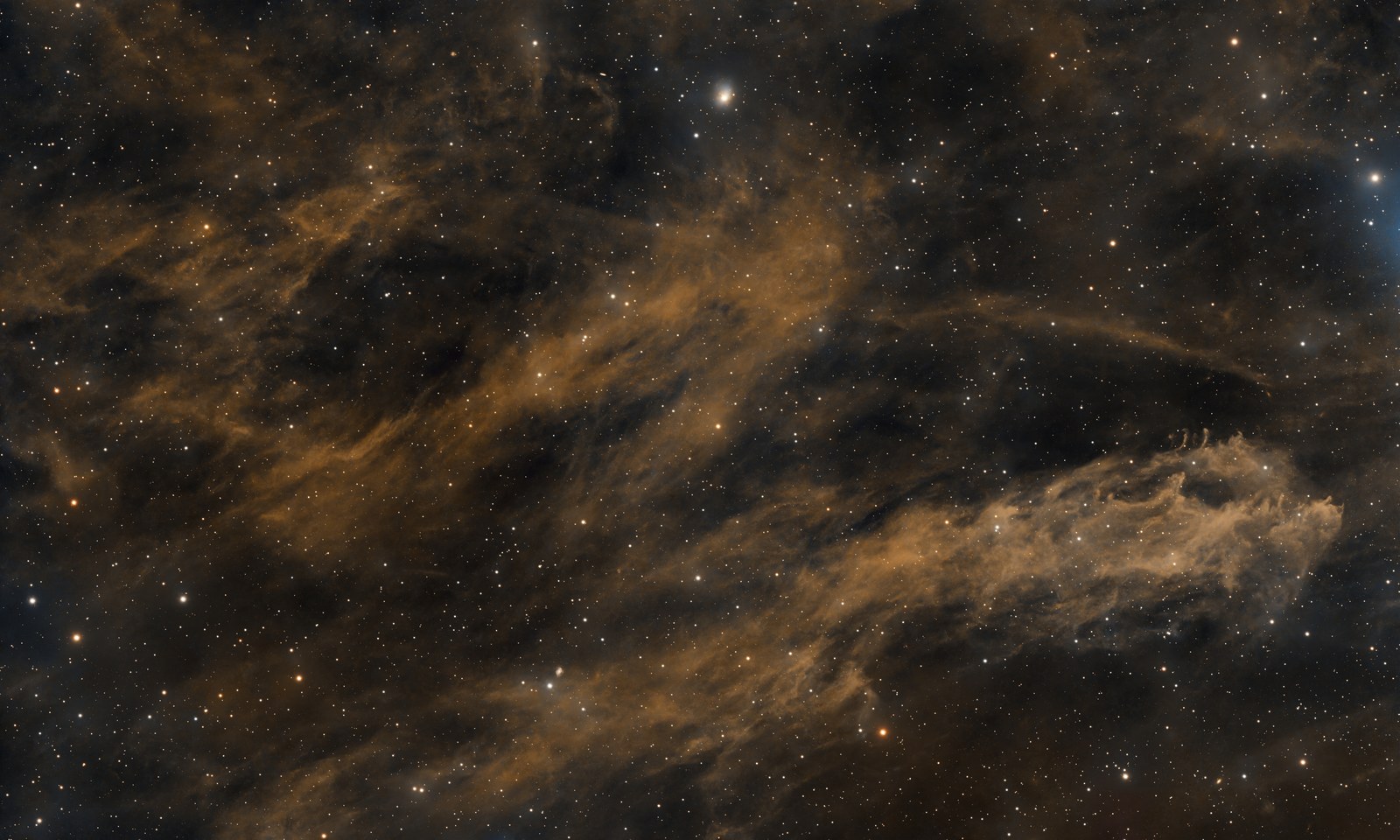
Dust Near the Pole
Order a print From 219€
Or give this image as a gift
Gift idea · ArtBox Gift Edition
Open edition · gallery-quality print, ready to give. Wooden frame, matte finish, gift box. To hang or stand.
Finish : Matte
Description
Far from the bright plane of the Milky Way, close to the celestial pole, drift faint ochre veils of dust. They do not shine like an emission nebula: these are grains of interstellar dust reflecting the combined light of all the stars in our galaxy. Astrophotographers call these tenuous veils galactic cirrus, or integrated flux nebula. They are so faint that hours of exposure are needed to bring them out.
The brightest patch, shaped like a feather, is LBN 629, the densest and best-lit knot of dust in the field. The dark lanes, where stars seem to vanish, are a dark cloud, LDN 1311, thick enough to hide whatever lies behind it. Here and there, tiny distant galaxies shine through the veil, proof that this dust stays translucent.
This whole field belongs to the Polaris Flare, a vast complex of clouds suspended above the galactic plane, about 490 light-years away (the distance is still debated). It is one of the most studied clouds in the sky: infrared telescopes have found a network of filaments and hundreds of dusty cores, potential seeds of stars. Yet almost none will ever collapse. The Polaris Flare is a cloud frozen just before stars are born, which makes it a precious record of the initial conditions.
Technical details
- Location :
- Rockwood, Texas, USA (Starfront Observatories)
- Date :
- 22-25-26/03/2026
- Celestial Coordinates :
- RA: 11h 34m 09s
Dec: +84° 00' 55" - Acquisition :
- 338 x 120s (11h16)
- Calibration :
- Offsets + Flats
- Mount :
- ZWO AM5
- Optics :
- Celestron Rasa 8
- Camera :
- Asi2600Mc Pro
- Filter :
- Antlia V-Pro Luminance 2"
- Distance :
- 490 light years
- Constellation :
- Camelopardalis