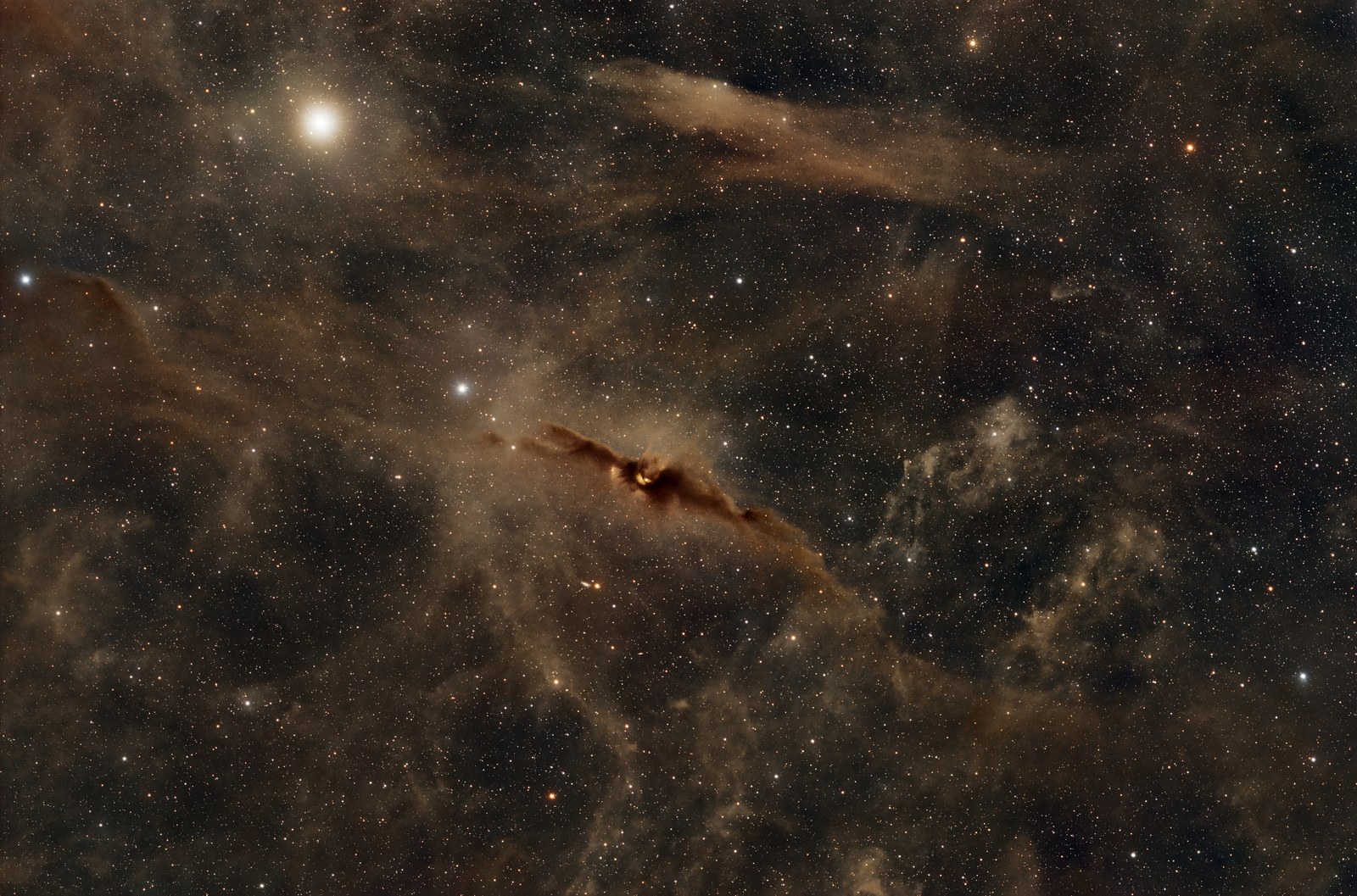
The Cosmic Bat
Order a print From 219€
Or give this image as a gift
Gift idea · ArtBox Gift Edition
Open edition · gallery-quality print, ready to give. Wooden frame, matte finish, gift box. To hang or stand.
Finish : Matte
Description
A bat with outstretched wings, frozen in the dark. The shape jumps out at you, but what you are looking at is not a glow: it is an absence. LDN 43 is a dark nebula, a cloud of gas and dust so cold and so dense that it does not shine at all. It blocks the light of the stars behind it, and the hole it cuts out of the sky is what draws the animal.
At the centre of the bat, two small golden patches betray what is going on inside. The larger one is lit by RNO 91, a protostar: a star still in the making, buried in its cocoon, which no telescope sees directly. It is not yet fusing hydrogen and shines only from its own contraction. Its light escapes through the cavity it has carved by blowing out gas, and what we see glowing are the walls of that cavity, split in two by the edge of its dust disc. The smaller patch nearby belongs to RNO 90, a slightly older star, between 2 and 6 million years old, already out of its cocoon and surrounded by a disc where planets may well be forming.
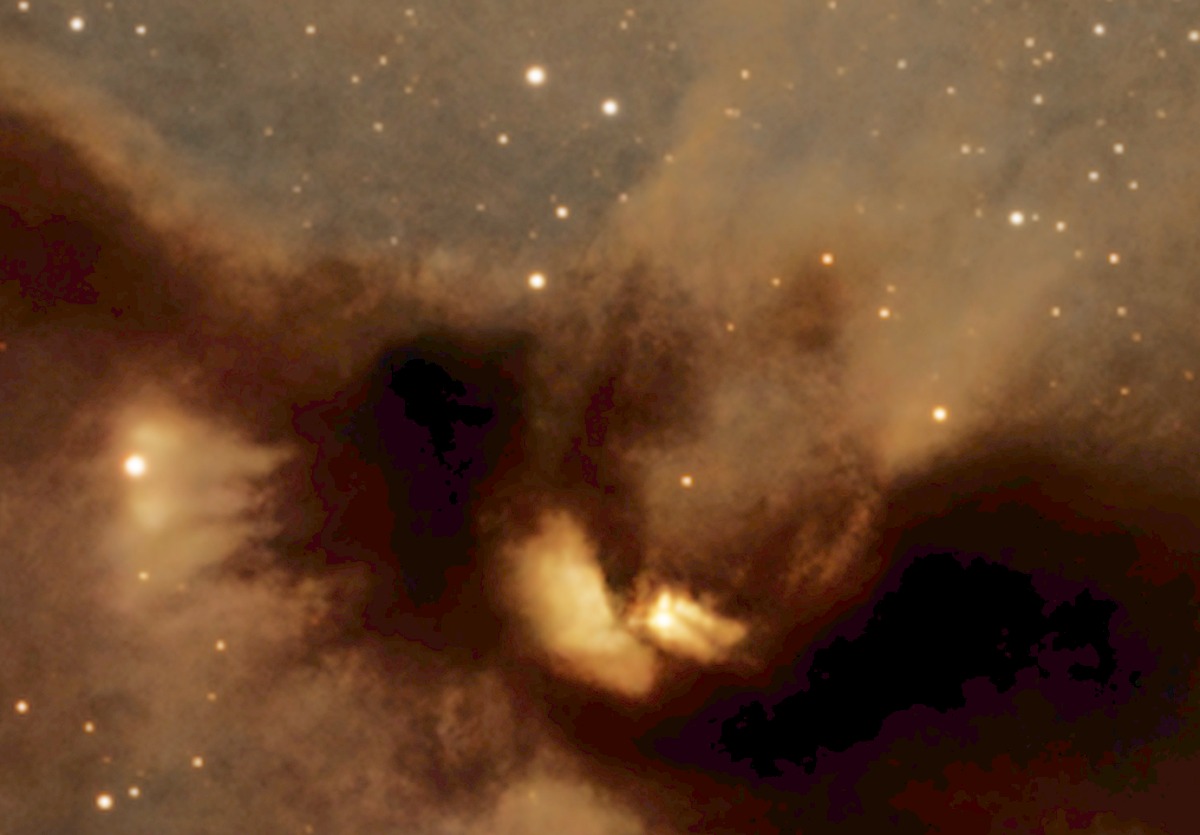
But the most interesting object in this cloud is the one no photograph will ever show. Between the two stars hides a starless core: the densest and coldest region of the cloud, completely invisible in visible light, detected only by telescopes working in the submillimetre range, far beyond red. Its mass is above the threshold at which gravity wins over everything else: it is probably collapsing in on itself, yet no star has been born there. This single frame therefore holds the three ages of a stellar birth: the core that has not started, the buried protostar, and the young star already set free.
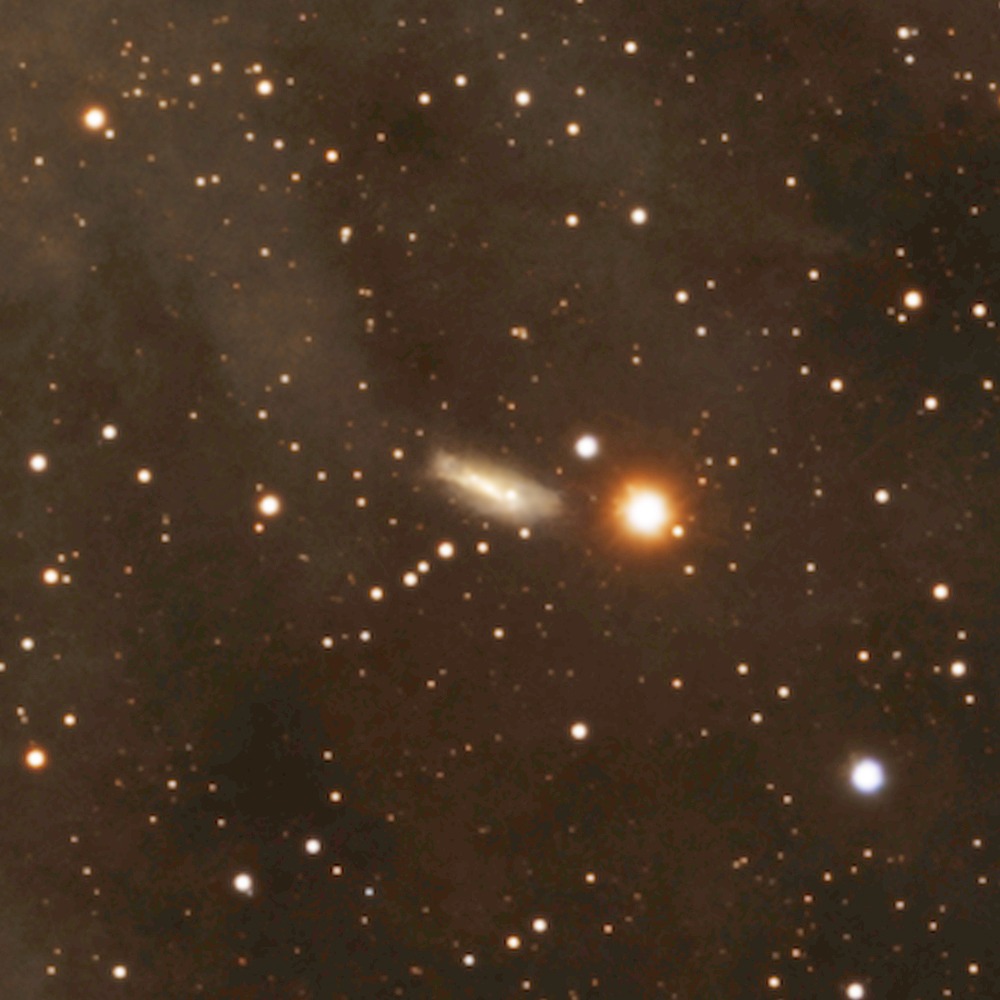
A word on the distance, because it is worth pausing on. Most images of this object quote 1,400 light years. Measurements from the Gaia satellite and the published work on this cloud give closer to 400 light years, within the Ophiuchus complex. The gap is not a detail: it divides the real size of the bat by three, making it a few light years across rather than twelve. Finally, low in the frame, the small elongated smudge sitting next to an orange star is a galaxy, LEDA 3868080, at 360 million light years. Roughly 900,000 times further away than the cloud at the centre of the image.
Technical details
- Location :
- Rockwood, Texas, USA (Starfront Observatories)
- Date :
- 22/06 + 07-08/07/2026
- Celestial Coordinates :
- RA : 16h 34m 49s
Dec : -15° 51′ 44″ - Acquisition :
- 88 x 240s (5h52m)
- Calibration :
- Offsets + Flats
- Mount :
- ZWO AM5
- Optics :
- Celestron Rasa 8
- Camera :
- ZWO ASI2600MC PRO
- Filter :
- Antlia V-Pro Luminance 2"
- Distance :
- 400 light years
- Constellation :
- Ophiuchus