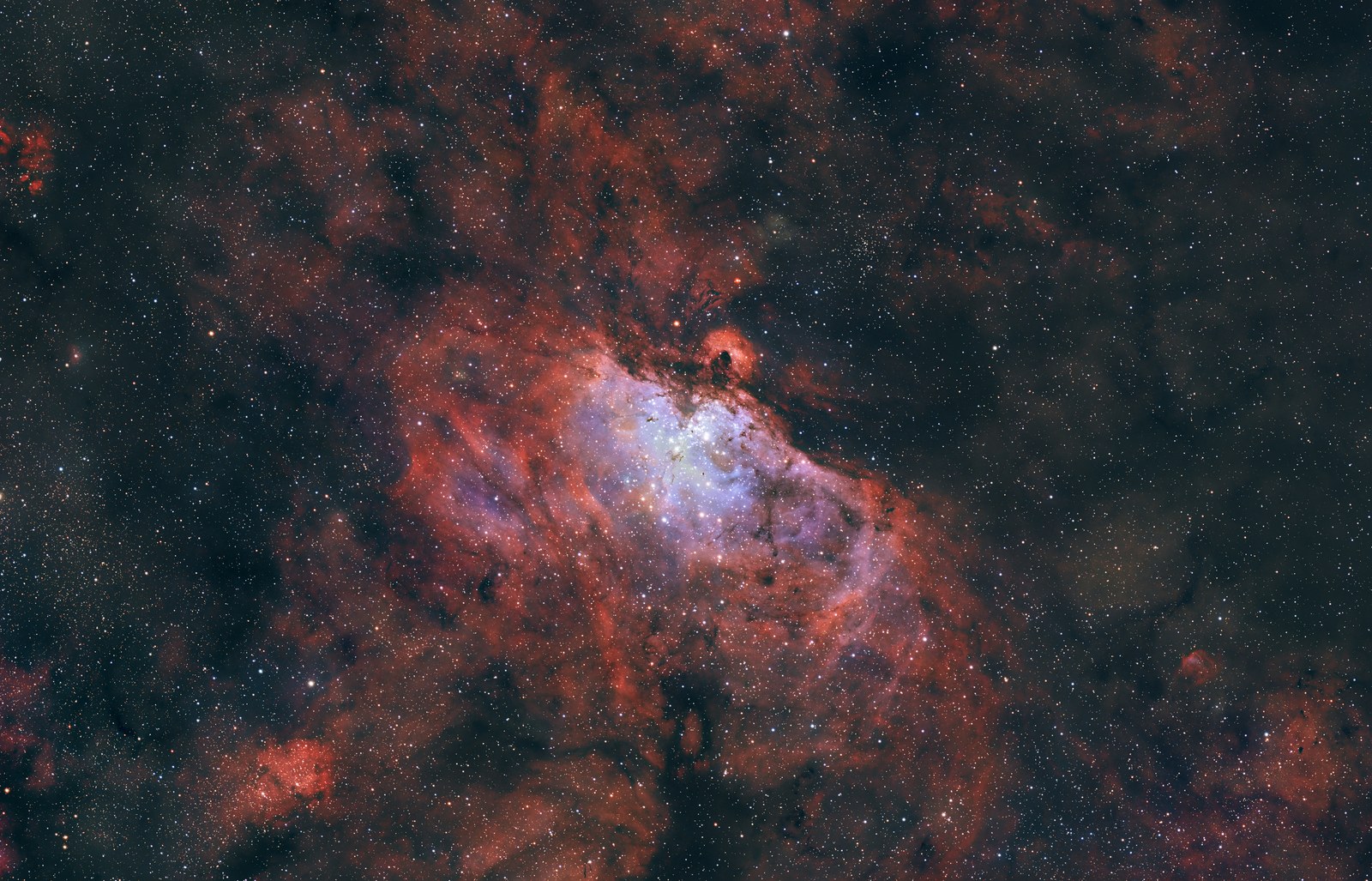
Eagle Nebula
Order a print From 219€
Or give this image as a gift
Gift idea · ArtBox Gift Edition
Open edition · gallery-quality print, ready to give. Wooden frame, matte finish, gift box. To hang or stand.
Finish : Matte
Description
Spotted around 1745 by Philippe Loys de Chéseaux and recovered by Charles Messier in 1764, the Eagle Nebula is one of the most famous stellar nurseries in the sky. It lies about 5,600 light years away, in the constellation Serpens, along the Sagittarius arm of our galaxy.
At the centre of the bluish cavity shines NGC 6611, a star cluster barely one to two million years old. Its most massive members, one of which approaches 80 solar masses, pour out ultraviolet radiation so intense that it carves and ionizes the surrounding gas cloud: this is what sculpts the whole region and makes it glow.
Silhouetted near the cluster stand the Pillars of Creation, made famous by Hubble in 1995 and revisited by the James Webb telescope in 2022, together with the Stellar Spire, a gas tower of the same kind. These dense columns slowly evaporate under the cluster's radiation while sheltering stars in the making.
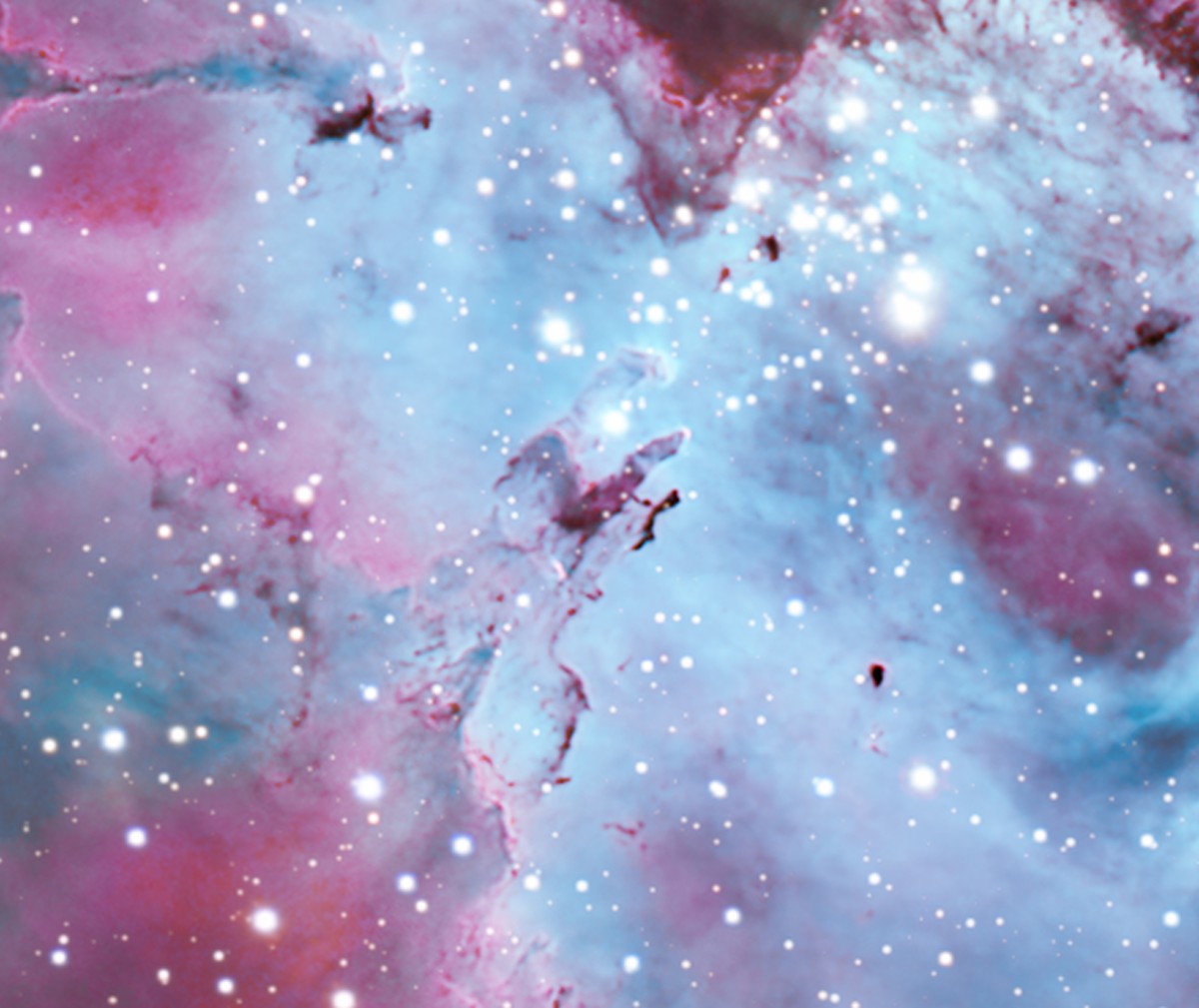
Long quoted at 7,000 light years, the distance of M16 has been revised to about 5,600 by the Gaia satellite. This wide field of more than three degrees puts the scene in context: the bright cavity is just a hollow carved into the edge of a huge dark molecular cloud. The HOO rendition maps hydrogen to golden hues and ionized oxygen to blue.
Technical details
- Location :
- Rockwood, Texas, USA (Starfront Observatories)
- Date :
- 08-09/06/2026 + 09-10/07/2026
- Celestial Coordinates :
- RA : 18h 18m 47s
Dec : -13° 48′ 33″ - Acquisition :
- HaOIII : 166 x 180s (8h18m) + RGB : 100 x 300s (8h20m) · Total : 16h38m
- Calibration :
- Offsets + Flats
- Mount :
- ZWO AM5
- Optics :
- Celestron Rasa 8
- Camera :
- ZWO ASI2600MC PRO
- Filter :
- Antlia V-Pro Luminance 2" + IDAS NBZ-II
- Distance :
- 5570 light years
- Constellation :
- Serpens