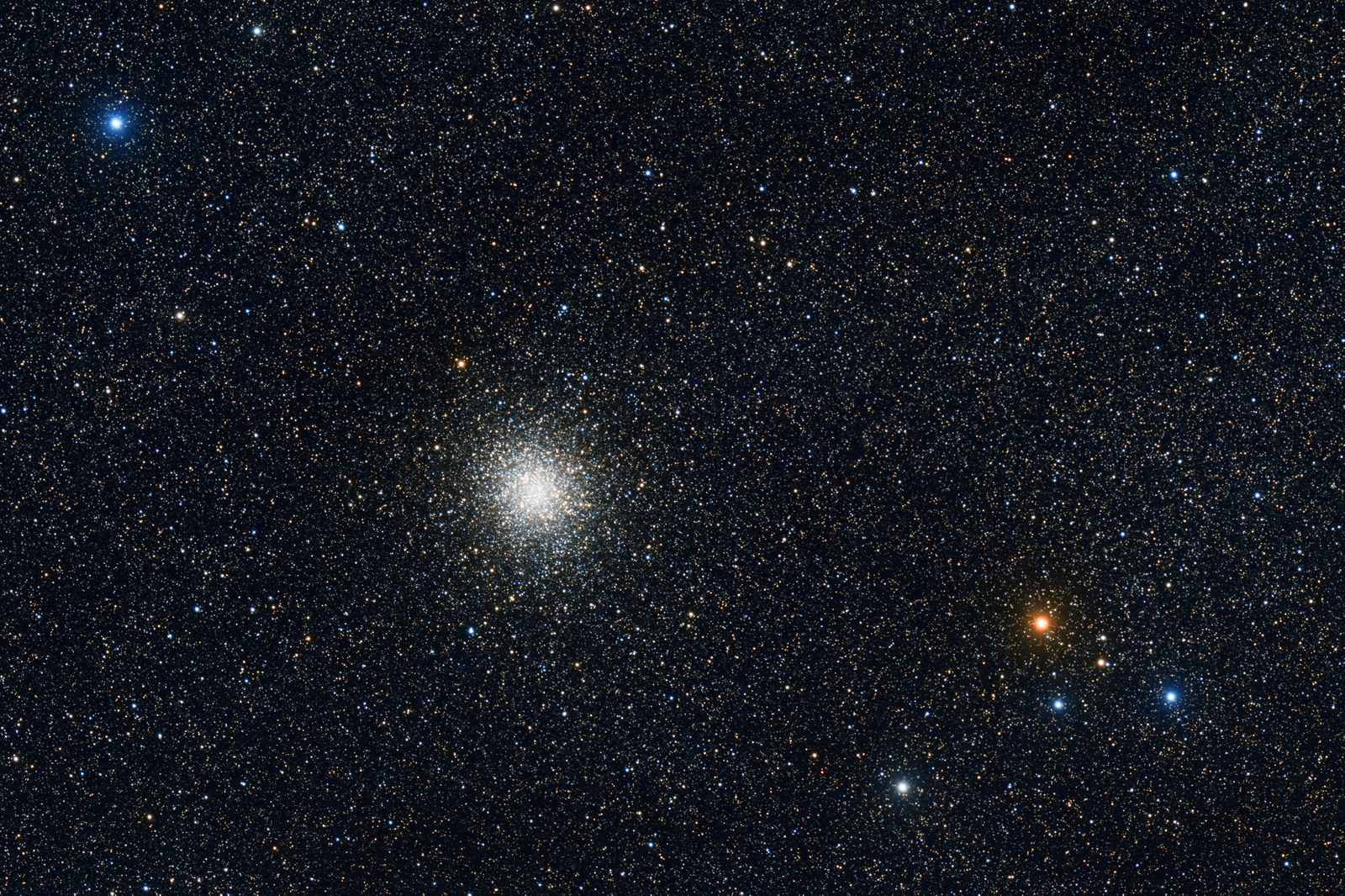
The Great Sagittarius Cluster
Order a print From 219€
Or give this image as a gift
Gift idea · ArtBox Gift Edition
Open edition · gallery-quality print, ready to give. Wooden frame, matte finish, gift box. To hang or stand.
Finish : Matte
Description
In the crowded star fields of Sagittarius, toward the centre of the Milky Way, M22 is one of the brightest and nearest globular clusters in the sky. This ball of several hundred thousand stars lies about 10,400 light-years away, close and luminous enough to be glimpsed with the naked eye. Noted as early as 1665 by Abraham Ihle, it is one of the very first globular clusters ever recorded, long before Charles Messier catalogued it.
M22 is no ordinary cluster. Unlike most globulars, whose stars all share the same composition, it shows a genuine spread in its content of heavy elements. This anomaly, found in only a handful of clusters such as Omega Centauri, suggests that M22 may not be a simple cluster but the surviving core of a small satellite galaxy, stripped of its outer stars by the Milky Way.
Its dense heart holds further surprises. Radio and X-ray observations have revealed two candidate stellar-mass black holes actively accreting matter, and models suggest the cluster may still harbour dozens of black holes. M22 is also one of the very few globular clusters known to host a planetary nebula, and an old nova remnant has been identified within it.
A globular cluster is a trap for the astrophotographer: its core is so concentrated that long exposures turn it into a saturated white blob. The image was therefore built from short 30-second frames, a compromise that preserves the resolution of the core stars while still recording the outer halo. It totals 1h18m of broadband exposure, acquired remotely from Texas.
Technical details
- Location :
- Rockwood, Texas, USA (Starfront Observatories)
- Date :
- 12/08/2026
- Celestial Coordinates :
- RA: 18h 35m 44s
Dec: -23° 51' 02" - Acquisition :
- 157 x 30s (1h18m)
- Calibration :
- Offsets + Flats
- Mount :
- ZWO AM5
- Optics :
- Celestron Rasa 8
- Camera :
- ZWO ASI2600MC PRO
- Filter :
- Antlia V-Pro Luminance 2"
- Distance :
- 10400 light years
- Constellation :
- Sagittarius