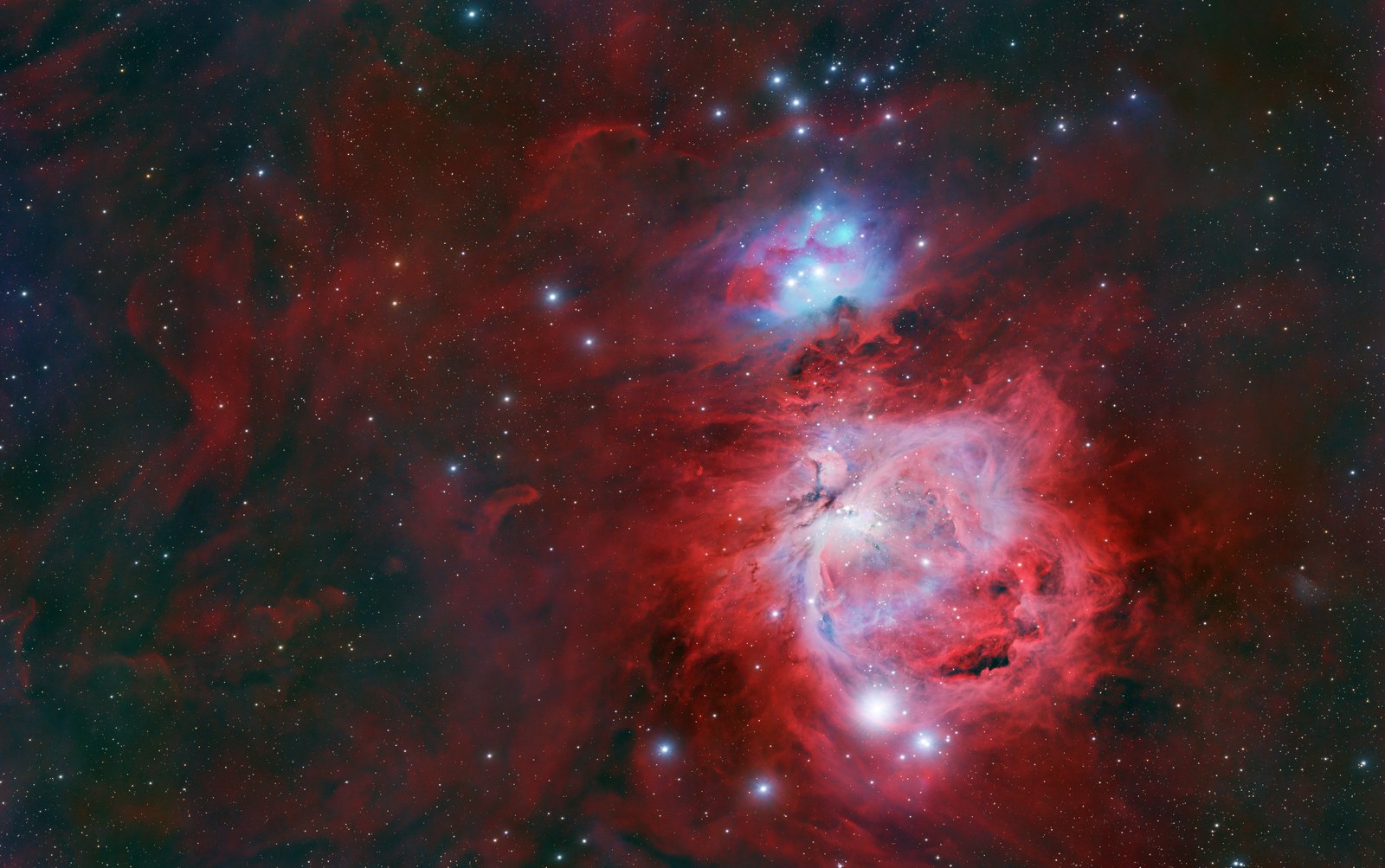
The Great Orion Nebula
Order a print From 219€
Or give this image as a gift
Gift idea · ArtBox Gift Edition
Open edition · gallery-quality print, ready to give. Wooden frame, matte finish, gift box. To hang or stand.
Finish : Matte
Description
In Orion's Sword, below the three aligned stars of the Belt, the naked eye makes out a small hazy patch. This is the Great Orion Nebula, the closest massive star-forming region to us, about 1,340 light-years away. People have always seen it, but it was in 1610 that Nicolas-Claude Fabri de Peiresc first spotted it through a telescope.
M42 is an immense cloud of gas and dust, about 24 light-years across. At its heart shines the Trapezium Cluster, four young, massive stars packed tightly together, whose ultraviolet radiation makes the whole nebula blaze. It is this energy that gives it its colours: the red of hydrogen and the blue-green of oxygen.
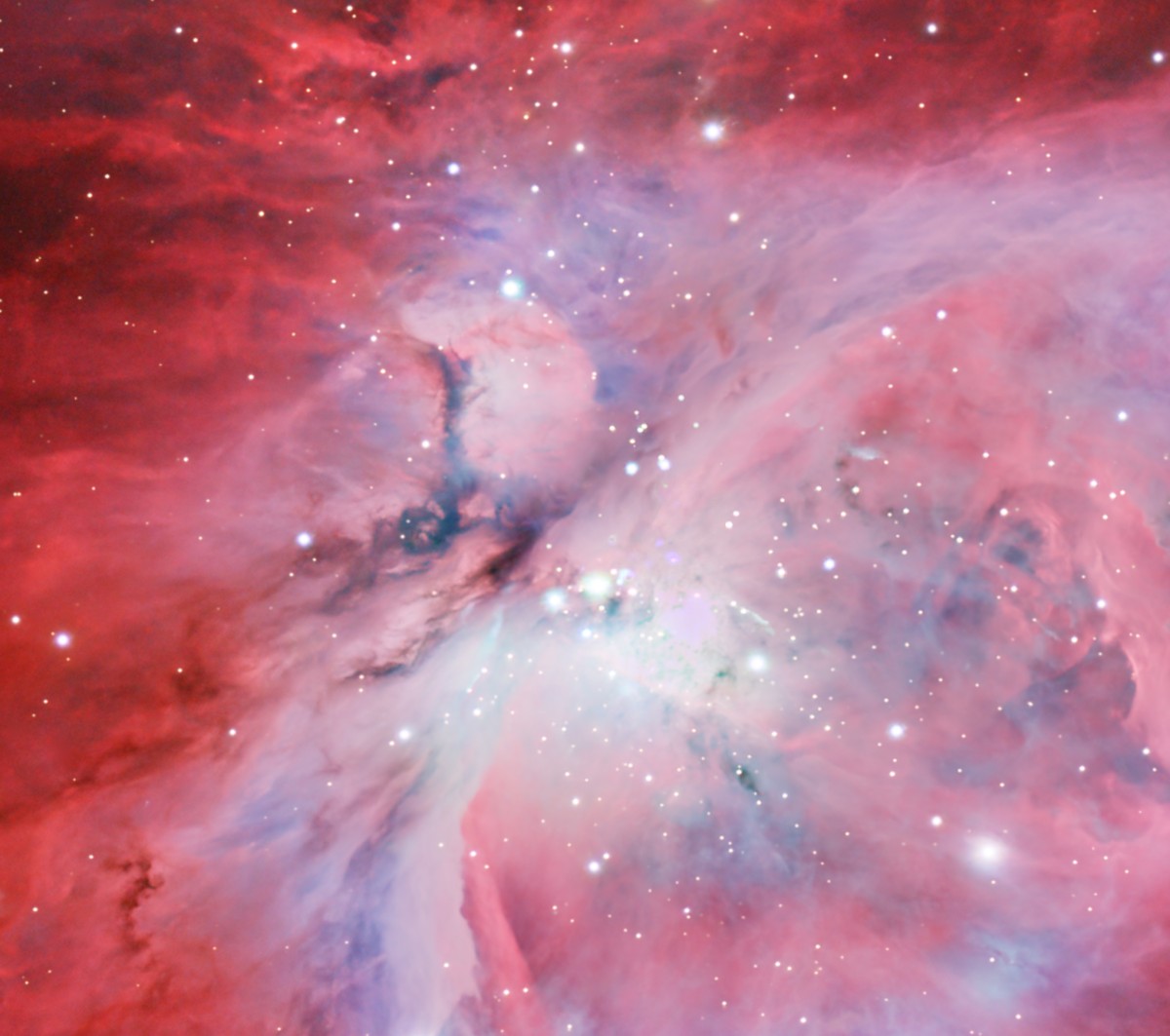
More than seven hundred stars are being born here, and some are already wrapped in a protoplanetary disk, a solar system in the making. This is what makes Orion one of the most precious laboratories for understanding how stars and planets form, as our own Sun did four and a half billion years ago.
Higher in the frame shines a quite distinct nebula, the Running Man (NGC 1977). It is a reflection nebula: its dust does not glow by itself, it scatters back in blue the light of young hot stars. A silhouette of dark dust traces a human figure in mid-stride, hence its nickname.
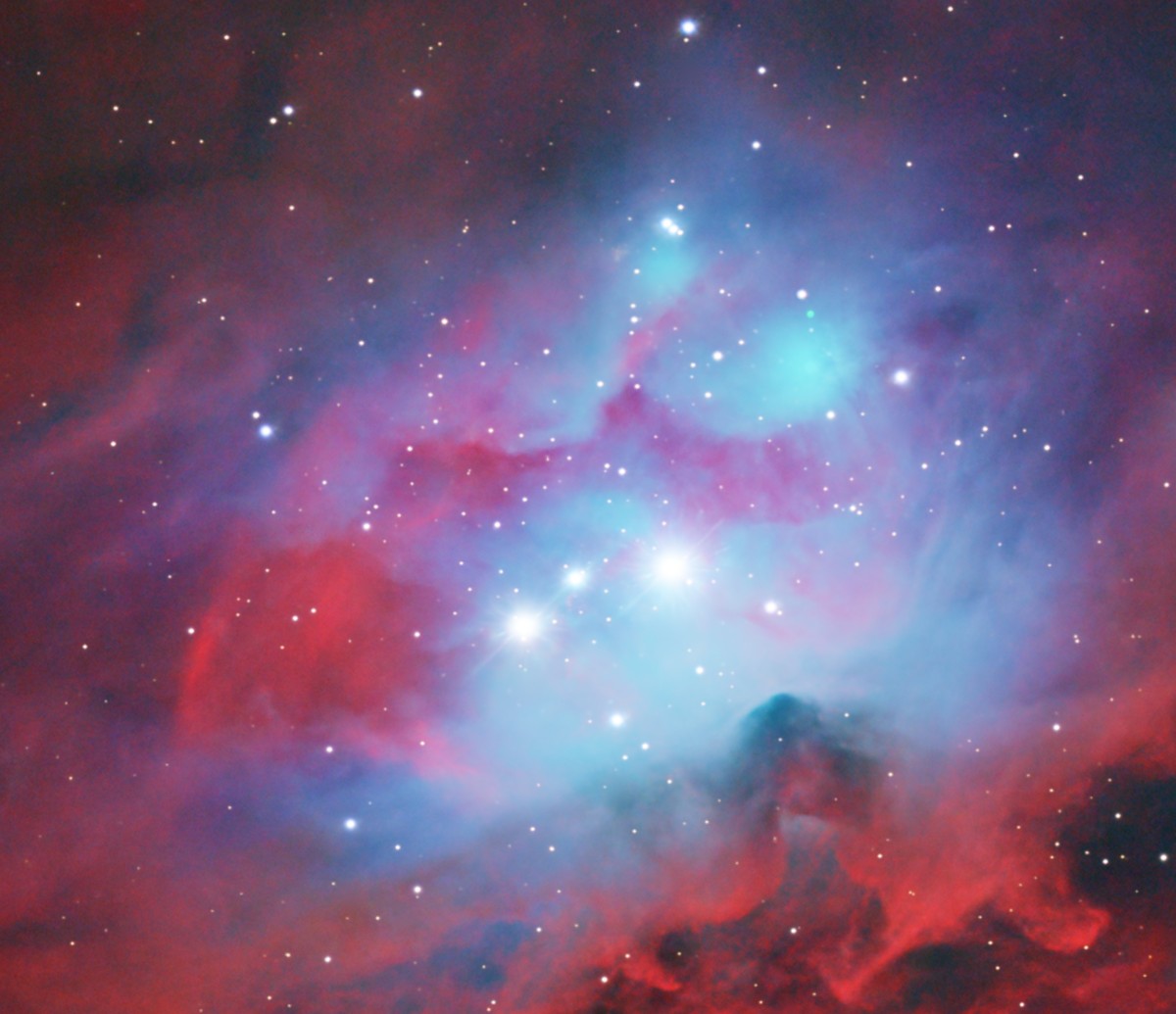
This image blends two views: the natural colours of the stars, and the light proper to hydrogen and oxygen, which brings out the finest structures of the cloud.
Technical details
- Location :
- Rockwood, Texas, USA (Starfront Observatories)
- Date :
- 01-15/02/2026
- Celestial Coordinates :
- RA: 05h 36m 46s
Dec: -05° 11' 25" - Acquisition :
- RGB : 204 x 60s (3h24m) + HaOIII : 49 x 60s (49min) · Total : 4h13m
- Calibration :
- Offsets + Flats
- Mount :
- ZWO AM5
- Optics :
- Celestron Rasa 8
- Camera :
- ASI2600MC PRO
- Filter :
- Antlia V-Pro Luminance 2" (RGB) + IDAS NBZ-II 2" (HaOIII)
- Distance :
- 1344 light years
- Constellation :
- Orion