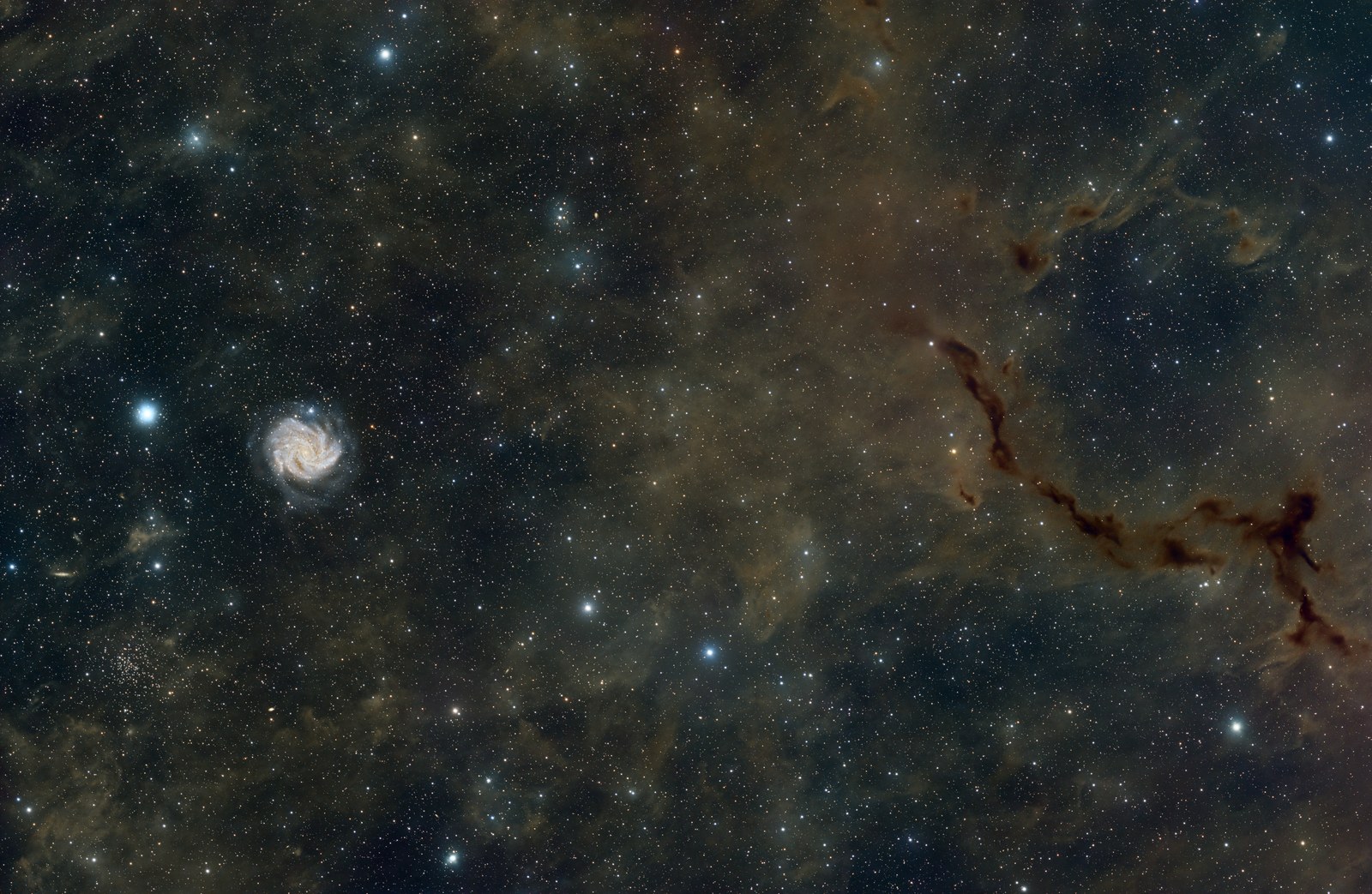
Dust and galaxy
Order a print From 219€
Or give this image as a gift
Gift idea · ArtBox Gift Edition
Open edition · gallery-quality print, ready to give. Wooden frame, matte finish, gift box. To hang or stand.
Finish : Matte
Description
This wide field brings together two objects that have nothing in common but the same direction in the sky. On the left, the small bluish face-on spiral is the Fireworks Galaxy (NGC 6946), about 25 million light-years away. On the right, the long dark ribbon coiled like the tail of a sea creature is the Seahorse Nebula (Barnard 150), a cloud of cold dust in our own galaxy, only 1,200 light-years away. Between them drifts a veil of ochre galactic dust.
NGC 6946 owes its nickname to a record: no known galaxy has seen as many supernovae explode within a single century. This spiral, seen face-on, forms stars at an intense rate. It lies just behind the plane of the Milky Way, on the border of Cepheus and Cygnus, so its light reaches us dimmed and reddened by the dust of our own galaxy in the foreground.
The Seahorse, by contrast, does not shine: it is a dense, cold cloud of dust that hides the stars behind it, tracing its shape as a silhouette. Its densest cores are potential cradles of future stars. Close by, at bottom left, a tight scatter of stars marks the open cluster NGC 6939, about 4,000 light-years away. The brown veil bathing the whole field is high-altitude galactic dust, lit obliquely by the combined light of the Milky Way. The dark cloud is twenty thousand times closer than the galaxy: they overlap only by an effect of perspective.
Gathering into a single image dust at 1,200 light-years and a galaxy twenty thousand times farther takes a wide field and a great deal of patience, for these faint veils are very dim. The image totals 12h30m of broadband exposure, acquired remotely from Texas.
Technical details
- Location :
- Rockwood, Texas, USA (Starfront Observatories)
- Date :
- 09-10-11/08/2026
- Celestial Coordinates :
- RA: 20h 42m 04s
Dec: +60° 07' 11" - Acquisition :
- 375 x 120s (12h30m)
- Calibration :
- Offsets + Flats
- Mount :
- ZWO AM5
- Optics :
- Celestron Rasa 8
- Camera :
- ZWO ASI2600MC PRO
- Filter :
- Antlia V-Pro Luminance 2"
- Distance :
- 1200 / 25200000 light years
- Constellation :
- Cepheus