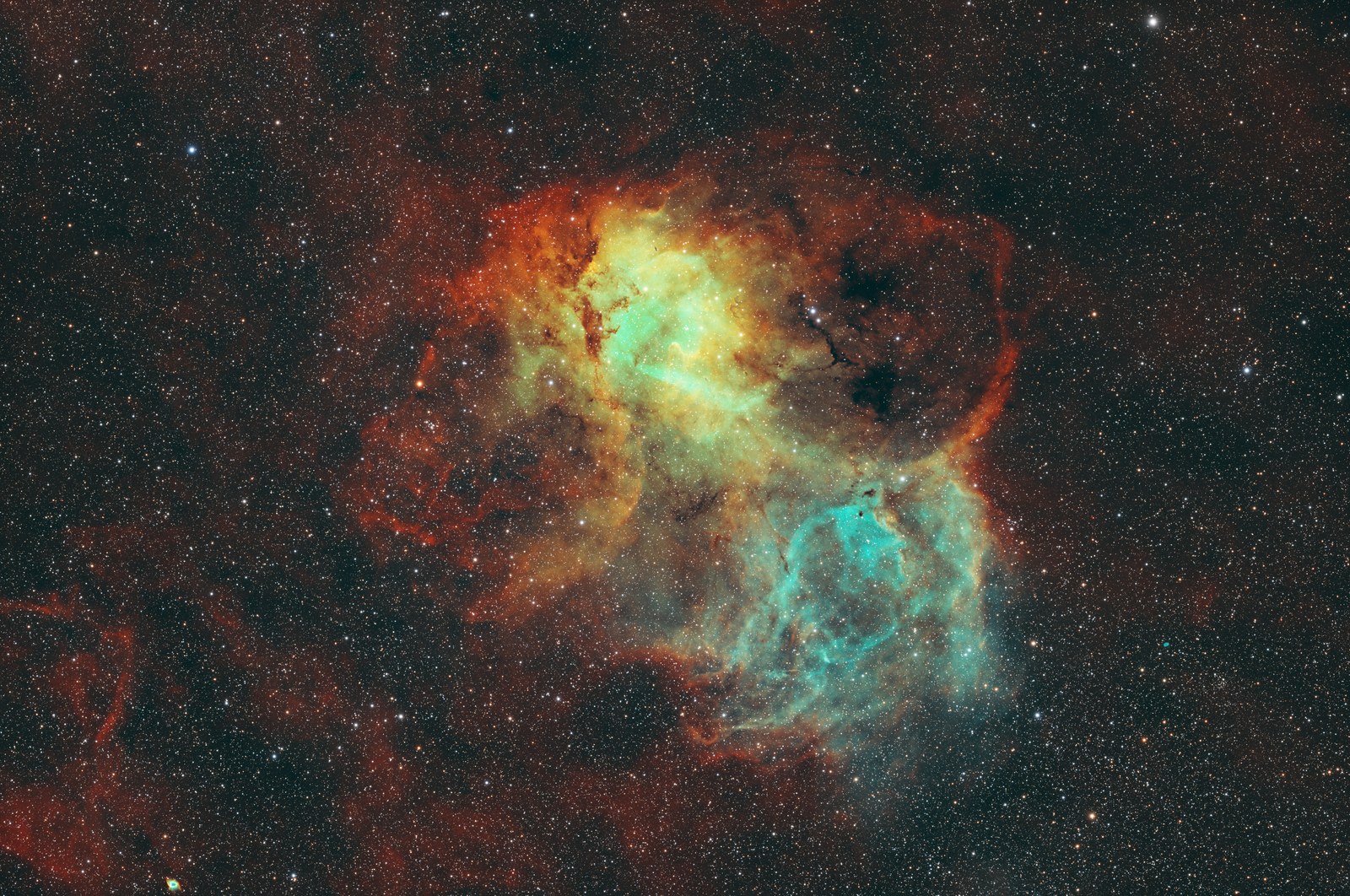
The Lion Nebula
Order a print From 219€
Or give this image as a gift
Gift idea · ArtBox Gift Edition
Open edition · gallery-quality print, ready to give. Wooden frame, matte finish, gift box. To hang or stand.
Finish : Matte
Description
A standing big cat, head turned to the left, body stretching across the right of the field: the shape that earned Sh2-132 its nickname emerges from a tangle of red gas, pierced by two large turquoise bubbles. Those bubbles are not holes in the nebula, they are cavities blown from within.
The object sits in Cepheus, some 10,000 light-years away, with recent studies placing it between 3.2 and 3.6 kiloparsecs. It belongs to the Cep OB1 association of massive stars and covers 42 by 30 arcminutes of sky, a region more than 200 light-years across.
Two Wolf-Rayet stars rule this field: HD 211564 (WR 152) and HD 211853 (WR 153), surrounded by many hot O and B-type stars. A Wolf-Rayet is a very massive star that has run through its hydrogen supply and is shedding its own substance in a wind reaching thousands of kilometres per second. That wind sweeps the surrounding gas and carves the shells seen here in turquoise: doubly ionised oxygen, which only lights up close to the hottest stars, while the dominant red comes from hydrogen, easier to excite and therefore far more widespread.
It is a fertile household. A 2010 study of the complex identified four previously unknown star clusters, aged between 1 and 15 million years, including one still buried in its parent cloud and another gathered around WR 152. That spread of ages, combined with the region's bubble-shaped structure, argues for triggered star formation: by compressing the gas ahead of them, generations of massive stars set off the birth of the next.
Sh2-132 is a demanding target. Its sulphur signal is faint and easily lost in the noise, and the oxygen shells need long exposure to lift off the sky background. This image totals 59h35 over thirteen nights in narrowband hydrogen, oxygen and sulphur, plus one night of luminance and colour used for the stars alone, so they keep a natural hue within a palette that is itself arbitrary.
Technical details
- Location :
- Amargosa Valley, Nevada, USA (Death Valley Observatories)
- Date :
- 23-24-25-31/08/2026 + 01-02-03-04-05-06-07-08-09/09/2026
- Celestial Coordinates :
- RA: 22h 19m 03s
Dec: +55° 51' 32" - Acquisition :
- 715 x 300s (59h 35m)
- Calibration :
- Offsets + Flats + Darks
- Mount :
- ZWO AM5N
- Optics :
- William Optics Cat 91 WIFD
- Camera :
- ZWO ASI2600MM PRO
- Filter :
- Astronomik Ha 6nm 2", Astronomik OIII 6nm 2", Astronomik SII 6nm 2", Astronomik L-3 Luminance UV/IR Block 2", Astronomik Deep-Sky RGB 2"
- Distance :
- 10400 light years
- Constellation :
- Cepheus