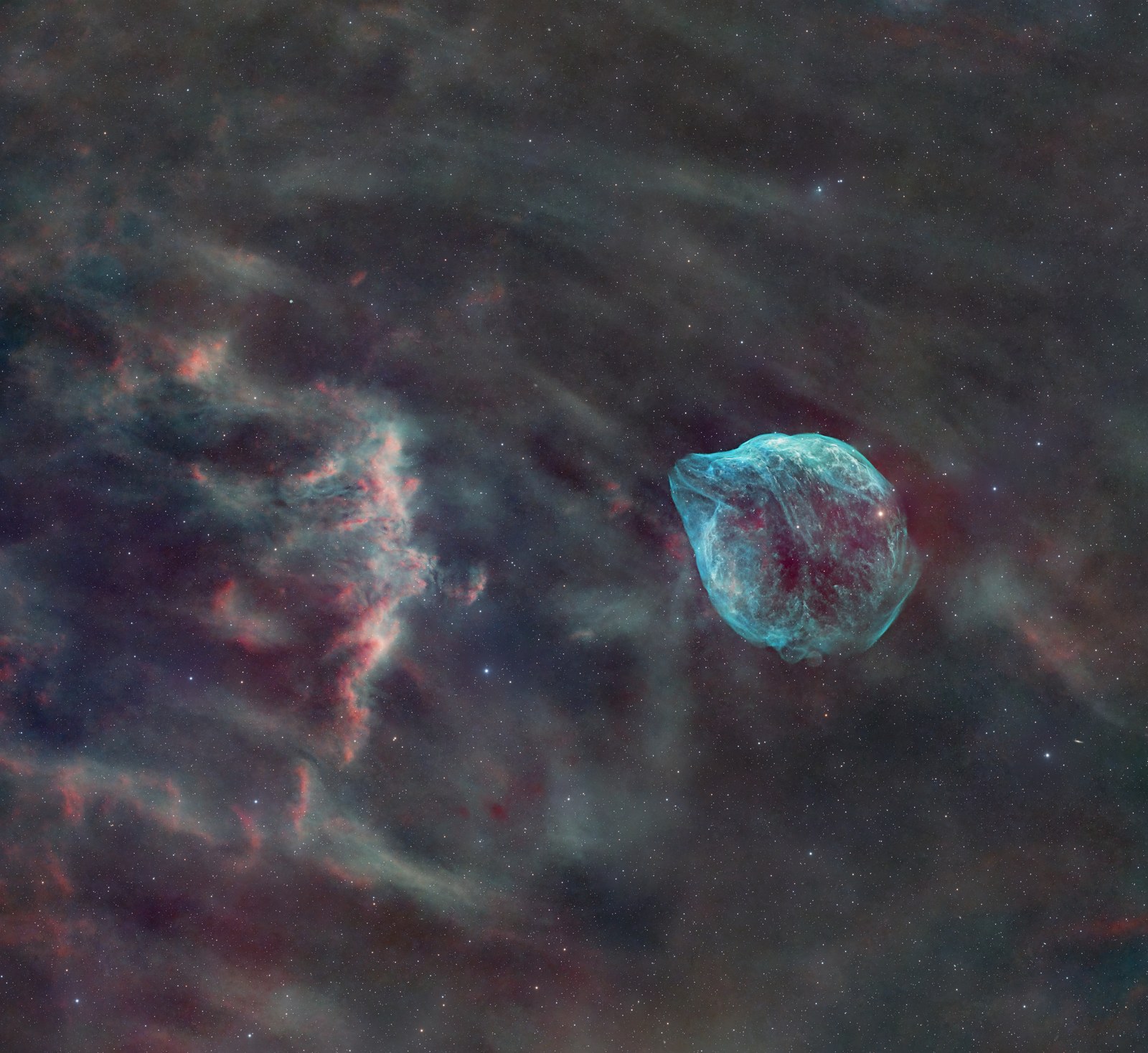
Dolphin Head Nebula
Order a print From 189€
Or give this image as a gift
Gift idea · ArtBox Gift Edition
Open edition · gallery-quality print, ready to give. Wooden frame, matte finish, gift box. To hang or stand.
Finish : Matte
Description
In the constellation of Canis Major, about 4,500 light-years away, a giant bubble swells silently through space. It has been nicknamed the Dolphin Head (Sh2-308), and it is the work of a single star, among the rarest and most violent in our galaxy.
At its centre watches EZ Canis Majoris, a Wolf-Rayet star: a colossal star very near its end. About 70,000 years ago, it began to cast off its outer layers, and it now blows a wind so fast, nearly 1,700 kilometres per second, that it sweeps up the material released earlier and inflates it into a bubble 60 light-years wide, slightly larger than the full Moon in the sky. This shell glows mostly in the light of oxygen, which gives it its blue-green hue and its dolphin shape.
It also has a rarity to its name: it is one of only two bubbles of this kind known to emit X-rays, along with the Crescent Nebula. As for the star, its fate is sealed: it will end as a supernova, on the scale of astronomical time.
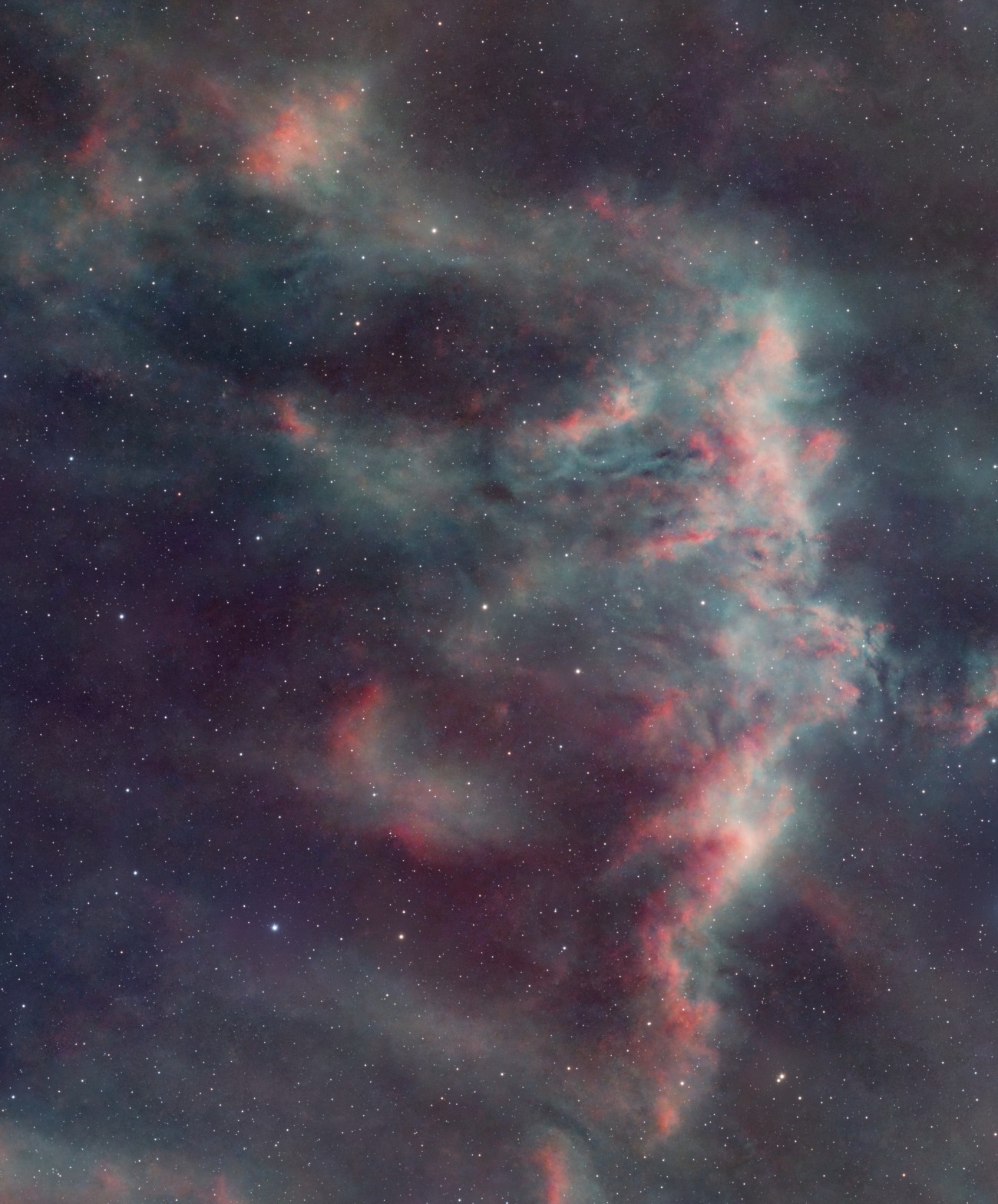
But the dolphin is not alone in the field. Right beside the bubble stretches Sh2-303, a vast hydrogen cloud whose glowing filaments recall a coral reef. The proximity is no accident: this cloud too is excited, in part, by the radiation of EZ Canis Majoris, the very star that blew the Dolphin Head. Where the bubble glows in blue-green oxygen, the reef blazes in the red of hydrogen.
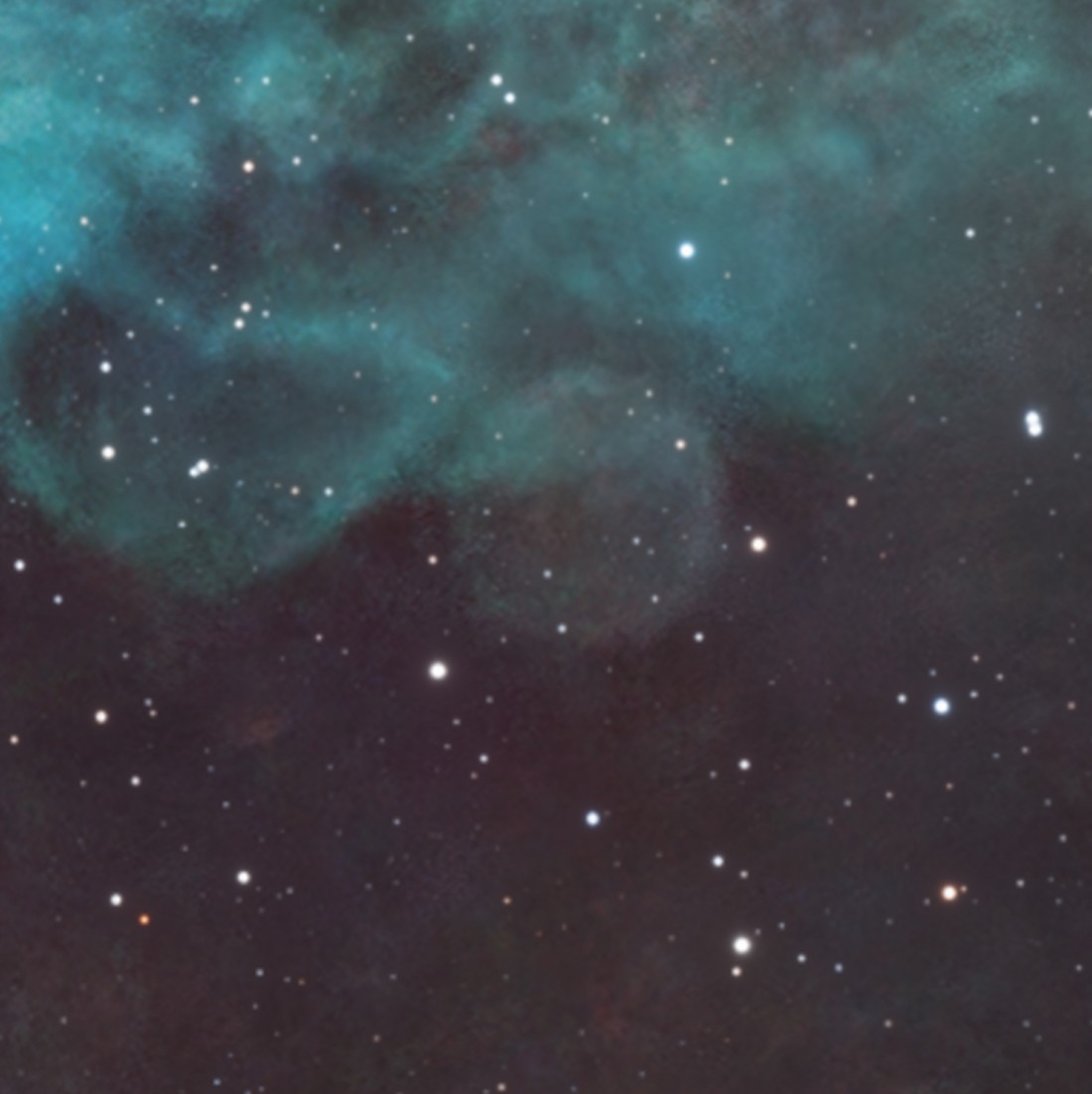
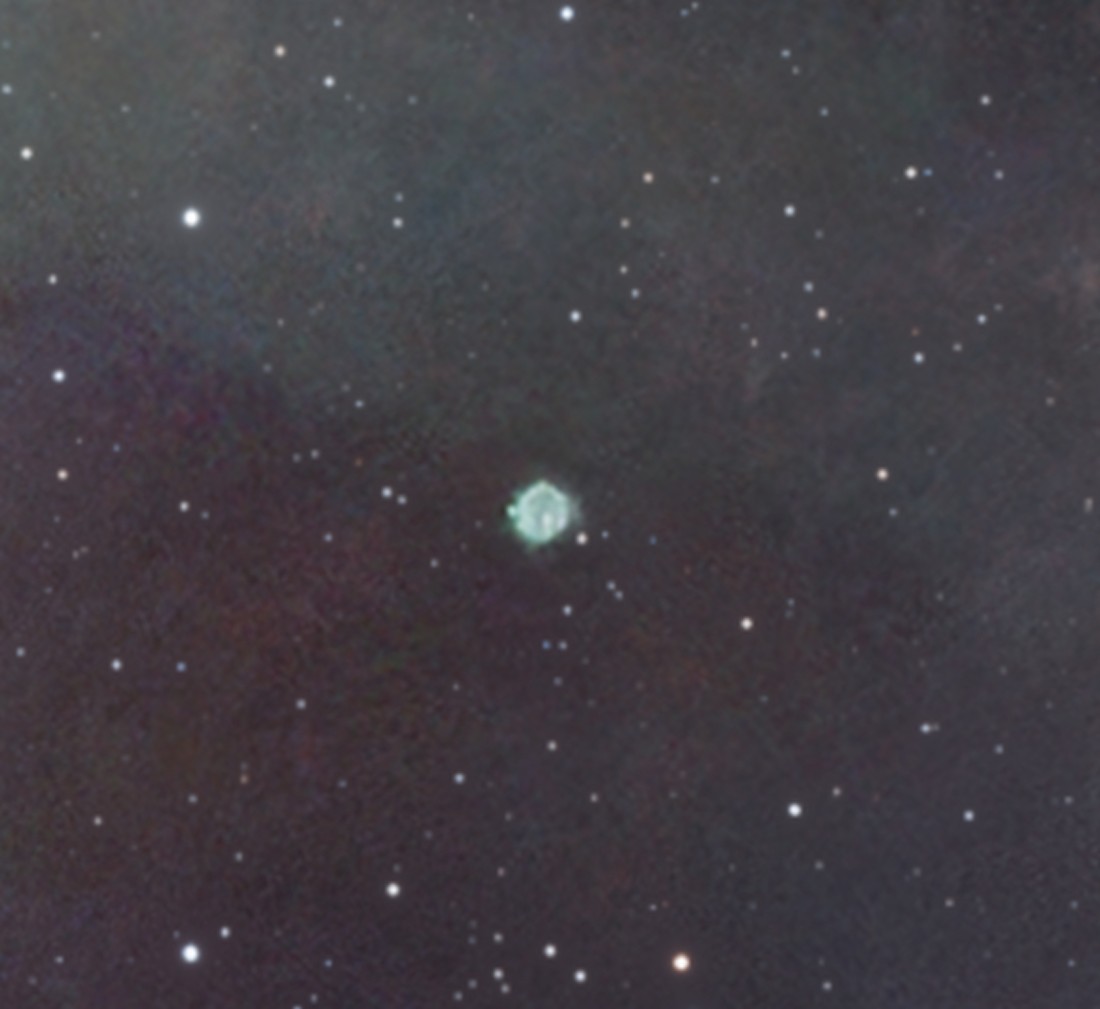
The field holds two more planetary nebulae, those shells of gas exhaled by far more modest stars reaching the end of their lives. The larger, MPA J0656-2356, traces a broad, faint ring nearly 170 arcseconds across, set against the lower edge of the bubble. The second, PK233-10.1, is tiny: a small blue-green disc one might take for a star, were it not for its colour and the star glimpsed shining through it.
The whole is so faint that it took special filters and long exposures to wrest it from the Texas sky, in two assembled panels. The AstroBin button, beneath the image, lets you explore the field at full resolution.
Technical details
- Location :
- Rockwood, Texas, USA (Starfront Observatories)
- Date :
- 23-26/02/2026 + 11-13/03/2026
- Celestial Coordinates :
- RA: 06h 53m 53s
Dec: -23° 14' 32" - Acquisition :
- 401 x 90s (10h 01m)
- Calibration :
- Offsets + Flats
- Mount :
- ZWO AM5
- Optics :
- Celestron Rasa 8
- Camera :
- ZWO ASI2600MC PRO
- Filter :
- IDAS NBZ-II
- Distance :
- 4530 light years
- Constellation :
- Canis Major