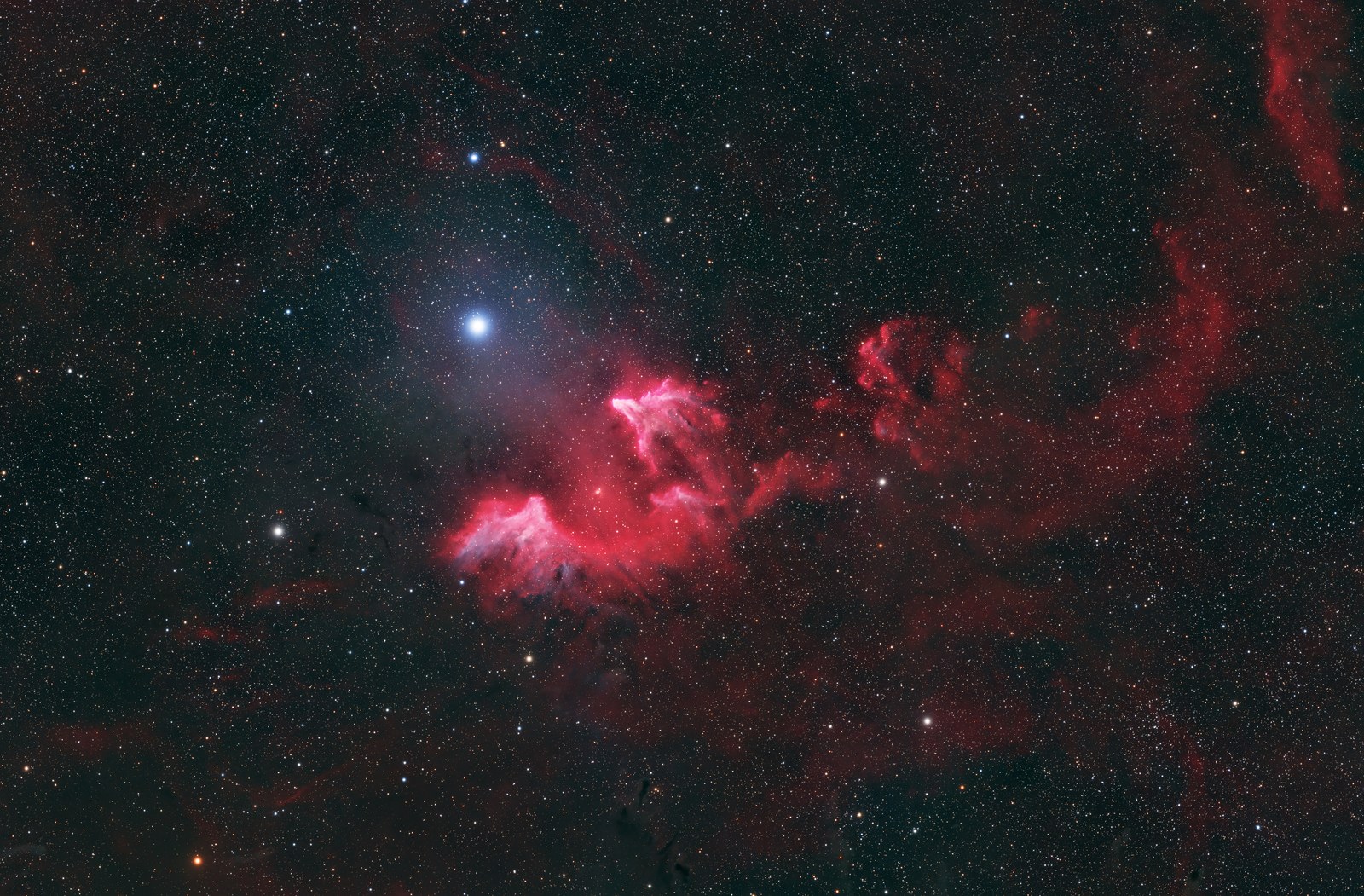
The Ghosts of Cassiopeia
Order a print From 219€
Or give this image as a gift
Gift idea · ArtBox Gift Edition
Open edition · gallery-quality print, ready to give. Wooden frame, matte finish, gift box. To hang or stand.
Finish : Matte
Description
Two pale shapes, like sheets lifted by the wind, seem to float in the middle of the red gas: these are the Ghosts of Cassiopeia. To the right of the very bright star at the top left lies IC 63, the most famous ghost, the one that gave the pair its nickname. Just below that same star lies its neighbour IC 59. Both clouds were discovered on the same night, 30 December 1893, by the German astronomer Max Wolf. They belong to a much larger region of ionized hydrogen, Sh2-185, whose red filaments stretch across the whole right side of the field.
The star is Gamma Cassiopeiae, the central star of the great W of Cassiopeia, easily visible to the naked eye from Belgium. It lies about 550 light-years away. It is a Be star: a hot blue star of around fifteen solar masses, spinning so fast that it surrounds itself with a disc of gas. It shines as brightly as 19,000 Suns. Astronaut Gus Grissom nicknamed it "Navi", his middle name, Ivan, spelled backwards.
Both ghosts are slowly vanishing under this radiation. They are photodissociation regions, cold clouds of gas and dust whose surface is being eroded by the star's ultraviolet light, and they are the closest such regions to the Sun. IC 63 lies about 7.5 light-years from Gamma Cas, slightly behind it, and IC 59 about 13.5 light-years away, slightly in front. On IC 63, the edge facing the star glows red: this is ionized hydrogen, the emission part. The bluish tints, on the other hand, come from dust reflecting the starlight, the reflection part, just like the blue glow spreading from Gamma Cas towards the clouds. Little by little, the radiation eats away at these clouds, gives them their comet-like shape, and will eventually disperse them.
This image totals 22 h 10 min over three nights in October 2026, from Nevada. Luminance and red, green and blue colour provide the stars and the natural tint of the clouds, while a hydrogen narrowband layer strengthens the red of the ionized gas.
Technical details
- Location :
- Amargosa Valley, Nevada, USA (Death Valley Observatories)
- Date :
- 18-19-22/10/2026
- Celestial Coordinates :
- RA: 01h 00m 09s
Dec: +60° 59' 28" - Acquisition :
- 266 x 300s (22h 10m)
- Calibration :
- Offsets + Flats + Darks
- Mount :
- ZWO AM5N
- Optics :
- William Optics Cat 91 WIFD
- Camera :
- ZWO ASI2600MM PRO
- Filter :
- Astronomik Ha 6nm 2", Astronomik L-3 Luminance UV/IR Block 2", Astronomik Deep-Sky RGB 2"
- Distance :
- 550 light years
- Constellation :
- Cassiopeia