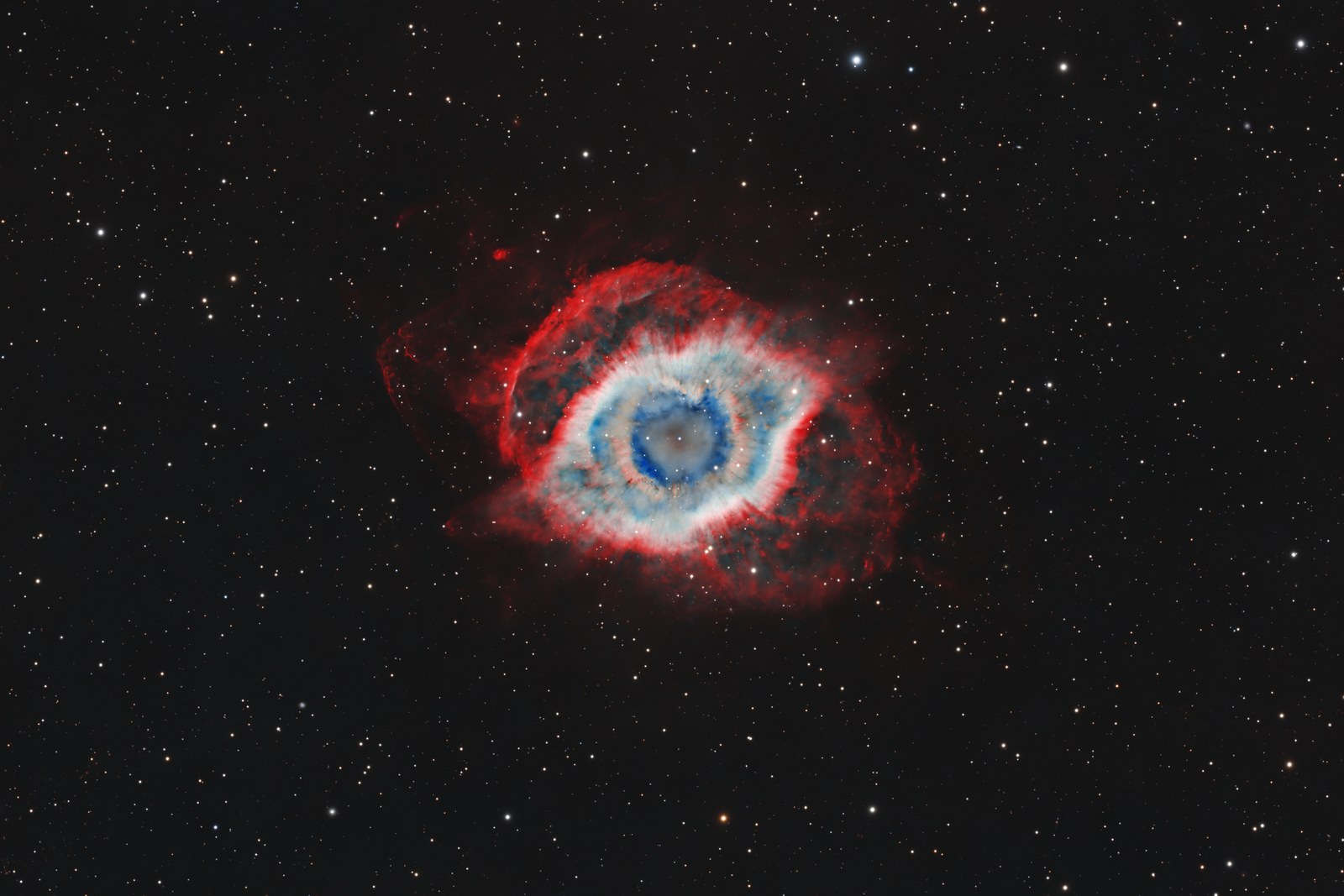
The Helix Nebula
Order a print From 219€
Or give this image as a gift
Gift idea · ArtBox Gift Edition
Open edition · gallery-quality print, ready to give. Wooden frame, matte finish, gift box. To hang or stand.
Finish : Matte
Description
A vast eye, its blue iris ringed with red, seemingly staring back at Earth from the depths of the sky: the Helix Nebula quickly earned the nickname "Eye of God". It lies in the constellation Aquarius, about 650 light-years away, making it one of the closest planetary nebulae to us. Discovered by the German astronomer Karl Ludwig Harding, probably before 1824, it covers an area of sky almost as large as the full Moon, yet it is far too faint to be seen with the naked eye.
A planetary nebula has nothing to do with planets: the name comes from the small disc these objects showed in 18th-century telescopes. It is in fact the end of life of a star like the Sun. Having run out of fuel, the star blew its outer layers into space and kept only its core, a white dwarf less than three times the size of Earth but more than twenty times hotter than the surface of the Sun. Its ultraviolet radiation makes the ejected gas glow, which now spans about 2.5 light-years. Based on its expansion speed, around thirty kilometres per second, the nebula is roughly ten thousand years old. This is the fate that awaits our own Sun in a few billion years.
The colours tell the story of this structure. At the centre, the blue comes from ionized oxygen, which only lights up closest to the star, where the radiation is most intense. Further out, the red of hydrogen traces the outer rings, and beyond them stretch fainter loops of material ejected earlier. Along the inner ring, the Helix also hosts some 40,000 "cometary knots": globules of dense gas, each as large as our Solar System, trailing a tail that points away from the star. It was the first planetary nebula in which they were discovered.
This image totals 25 h 50 min over six nights in October 2026, from Nevada. With a declination of nearly -21°, the Helix stays low for northern hemisphere observers: it never climbs above 33° from the observatory, and barely 18° from Belgium. Five nights of hydrogen and oxygen narrowband went into the nebula, one night of colour into the stars. The result is a so-called HOO image, where red comes from hydrogen and blue from oxygen, with stars in natural colours.
Technical details
- Location :
- Amargosa Valley, Nevada, USA (Death Valley Observatories)
- Date :
- 05-06-07-08-09-12/10/2026
- Celestial Coordinates :
- RA: 22h 29m 40s
Dec: -20° 50' 54" - Acquisition :
- 310 x 300s (25h 50m)
- Calibration :
- Offsets + Flats + Darks
- Mount :
- ZWO AM5N
- Optics :
- William Optics Cat 91 WIFD
- Camera :
- ZWO ASI2600MM PRO
- Filter :
- Astronomik Ha 6nm 2", Astronomik OIII 6nm 2", Astronomik Deep-Sky RGB 2"
- Distance :
- 650 light years
- Constellation :
- Aquarius