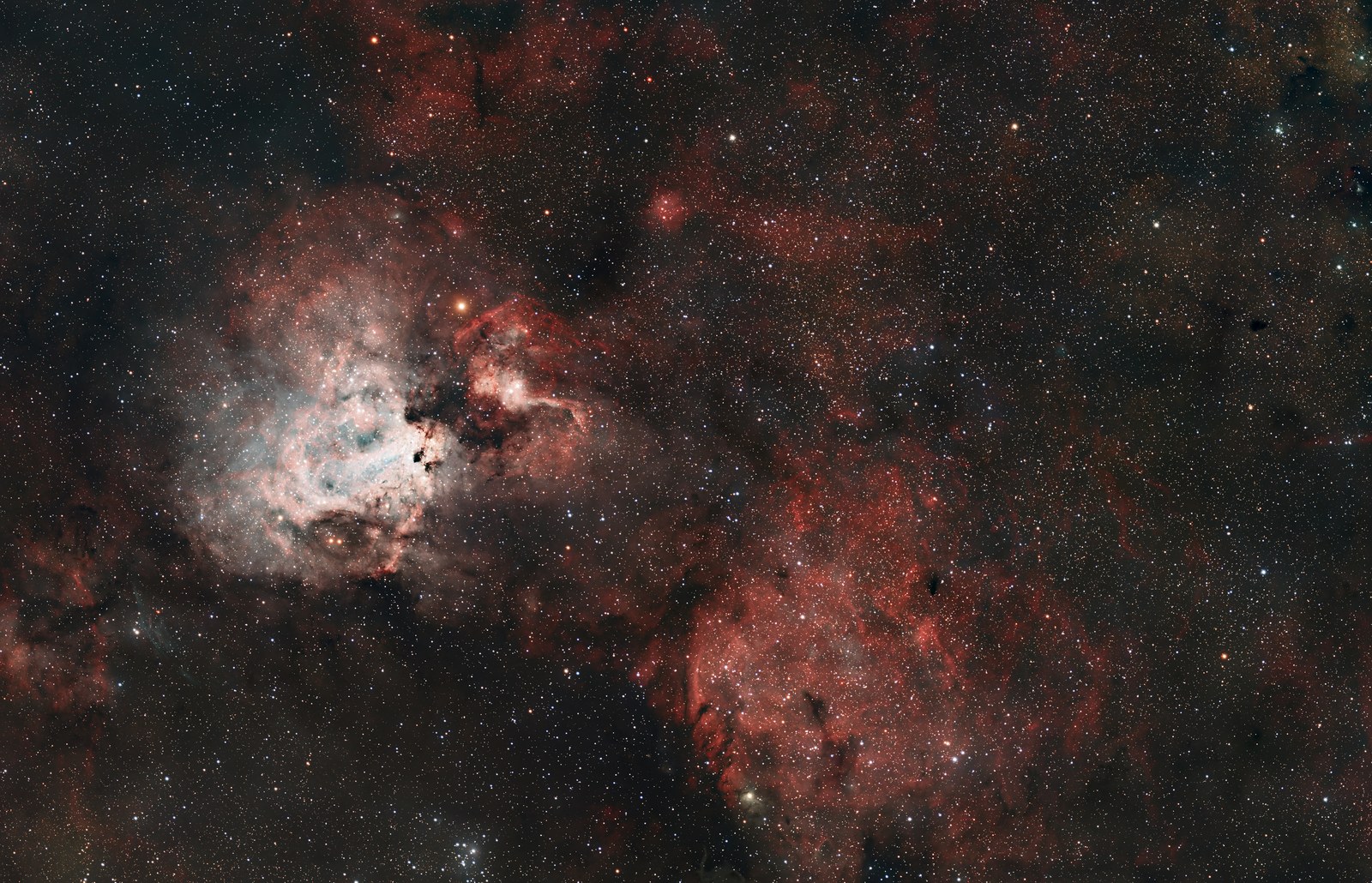
Omega Nebula
Order a print From 219€
Or give this image as a gift
Gift idea · ArtBox Gift Edition
Open edition · gallery-quality print, ready to give. Wooden frame, matte finish, gift box. To hang or stand.
Finish : Matte
Description
In the constellation Sagittarius, about 5,500 light-years away, the Omega Nebula is one of the largest and brightest star-forming regions in our galaxy. Spotted by Philippe Loys de Chéseaux around 1745 and then catalogued by Charles Messier in 1764, it also goes by the Swan Nebula or the Horseshoe Nebula, depending on the shape each observer reads into its glowing arc of gas.
That bright bar is really the lit face of a giant cloud of gas. At its heart sits the young cluster NGC 6618, less than a million years old, gathering more than a hundred hot stars including at least sixteen O-type giants. Their ultraviolet radiation ionizes the gas and makes it glow. Right beside it, the broad dark notch cutting into the bright core is not empty space: it is the dense molecular cloud the cluster was born from, seen almost edge-on, blocking the light behind it.
The nebula does not sit in front of its cloud, it glows on its edge: a blister of hot gas opening on the flank of a huge dark molecular cloud. And the story is not over. Millimetre telescopes still detect disks of material around young stars in the process of forming, proof that the region is building stars to this day.
Long placed between 5,000 and 6,500 light-years, its distance was refined by the Gaia satellite to around 5,500 light-years. This image gathers 13h 35m of exposure from Texas: a broadband base for natural star colours, enriched with narrowband (hydrogen and ionized oxygen) to reveal the gas, hydrogen in golden tones and oxygen in the blue-green shades of the core.
Technical details
- Location :
- Rockwood, Texas, USA (Starfront Observatories)
- Date :
- 13-16/06/2026 + 11-18/07/2026
- Celestial Coordinates :
- RA : 18h 17m 59s
Dec : -16° 07′ 44″ - Acquisition :
- HaOIII : 140 x 180s (7h00m) + RGB : 79 x 300s (6h35m) · Total : 13h35m
- Calibration :
- Offsets + Flats
- Mount :
- ZWO AM5
- Optics :
- Celestron Rasa 8
- Camera :
- ZWO ASI2600MC PRO
- Filter :
- Antlia V-Pro Luminance 2" + IDAS NBZ-II
- Distance :
- 5460 light years
- Constellation :
- Sagittarius