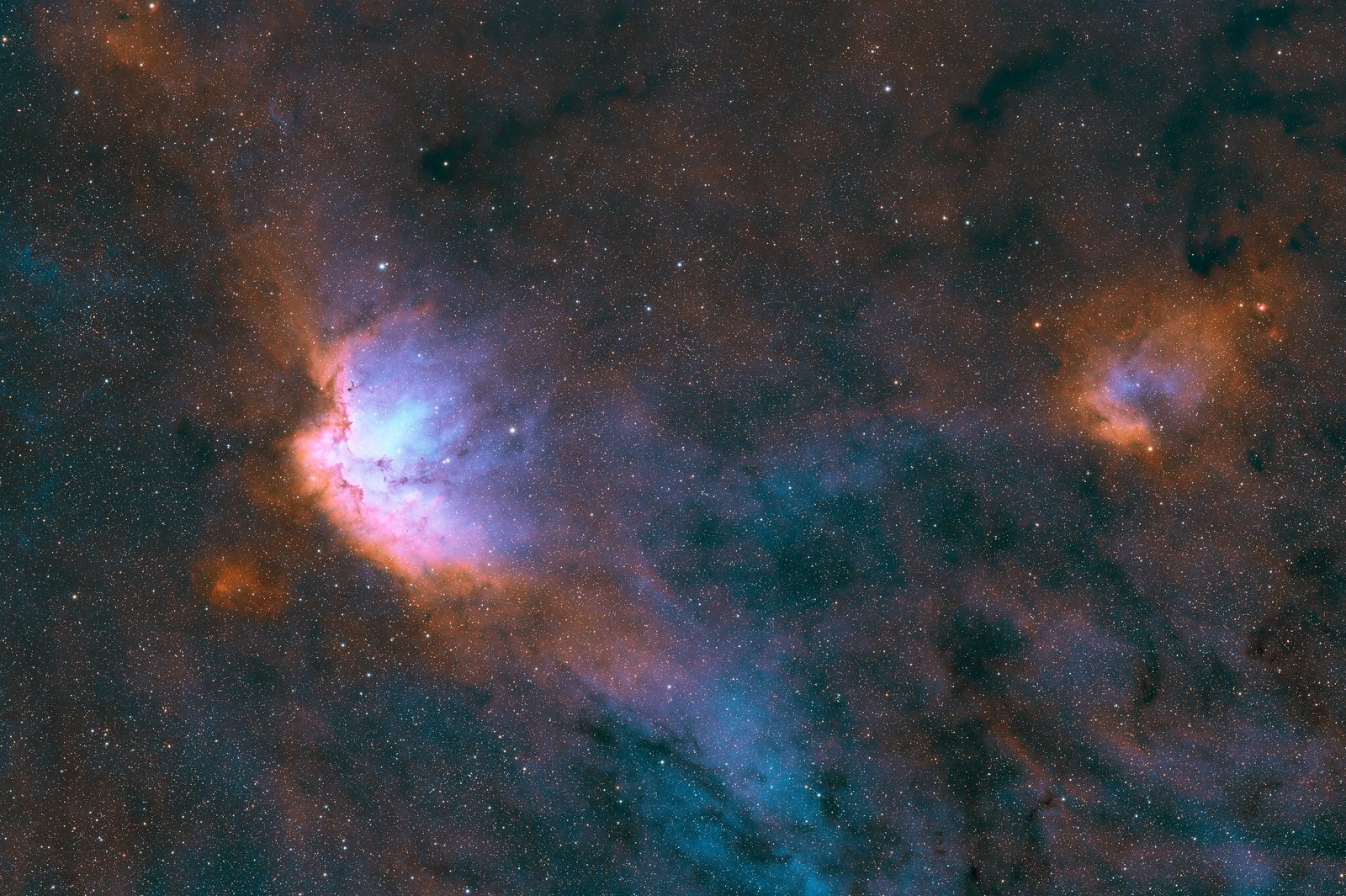
The Wizard Nebula
Order a print From 219€
Or give this image as a gift
Gift idea · ArtBox Gift Edition
Open edition · gallery-quality print, ready to give. Wooden frame, matte finish, gift box. To hang or stand.
Finish : Matte
Description
A hooded figure leaning to the left, one arm outstretched: that was enough for Sh2-142 to be nicknamed the Wizard Nebula. It lies in the constellation Cepheus, about 7,200 light-years away, and spans roughly a hundred light-years. At its heart shines NGC 7380, a young open cluster spotted by Caroline Herschel in 1787, a few years before her brother William added it to his catalogue.
The cluster is very young, only a few million years old, and it is what lights up the surrounding gas. Its most remarkable star is DH Cephei, a tight pair of O-type stars of about thirty solar masses each, orbiting one another in just over two days. Their ultraviolet light ionises the hydrogen, which glows red, and the oxygen, which takes on the blue-green hue so visible at the centre. The denser, darker left edge of the nebula is being eaten away by that light: the pillars and fringes seen there are what remains of the cloud that gave birth to the cluster.
On the right of the field, a second, more modest cloud also glows in hydrogen. Seen like this, it is hard not to imagine that the wizard has just cast a fireball. In reality, the bluish filaments that run across the whole lower part of the image and link the two regions are ionised oxygen, a faint signal that takes many hours of exposure to reveal.
This image totals 41 h 30 over seven nights in September 2026. Four nights of luminance and colour were used for the stars, three nights of narrowband hydrogen and oxygen for the nebula. The result is a so-called HOO image, where red comes from hydrogen and blue from oxygen, with stars in natural colours.
Technical details
- Location :
- Amargosa Valley, Nevada, USA (Death Valley Observatories)
- Date :
- 11-12-13-14-15-16-17/09/2026
- Celestial Coordinates :
- RA: 22h 42m 24s
Dec: +58° 07' 41" - Acquisition :
- 498 x 300s (41h 30m)
- Calibration :
- Offsets + Flats + Darks
- Mount :
- ZWO AM5N
- Optics :
- William Optics Cat 91 WIFD
- Camera :
- ZWO ASI2600MM PRO
- Filter :
- Astronomik Ha 6nm 2", Astronomik OIII 6nm 2", Astronomik L-3 Luminance UV/IR Block 2", Astronomik Deep-Sky RGB 2"
- Distance :
- 7200 light years
- Constellation :
- Cepheus